


H1 How Transistors Work: BJT and MOSFET Explained
Introduction
Have you ever wondered what makes your smartphone work, controls the speed of your computer's fan, or switches on your LED lights? The answer lies in tiny components called transistors - the unsung heroes of modern electronics. As an engineering student or DIY enthusiast in India, understanding how transistors work is crucial for your journey into electronics design.
From the bustling streets of Mumbai to the tech hubs of Bangalore and Hyderabad, transistors form the backbone of countless projects, from simple LED circuits to complex microcontrollers. Whether you're building a home automation system, designing a power supply, or creating IoT devices, transistors are your best friends.
In this comprehensive guide, we'll explore both BJT (Bipolar Junction Transistors) and MOSFET (Metal-Oxide-Semiconductor Field-Effect Transistors) in detail. We'll dive into their physics, practical applications, and even include code examples for microcontroller-controlled circuits. Let's get started on this electrifying journey into the world of transistors!
Prerequisites
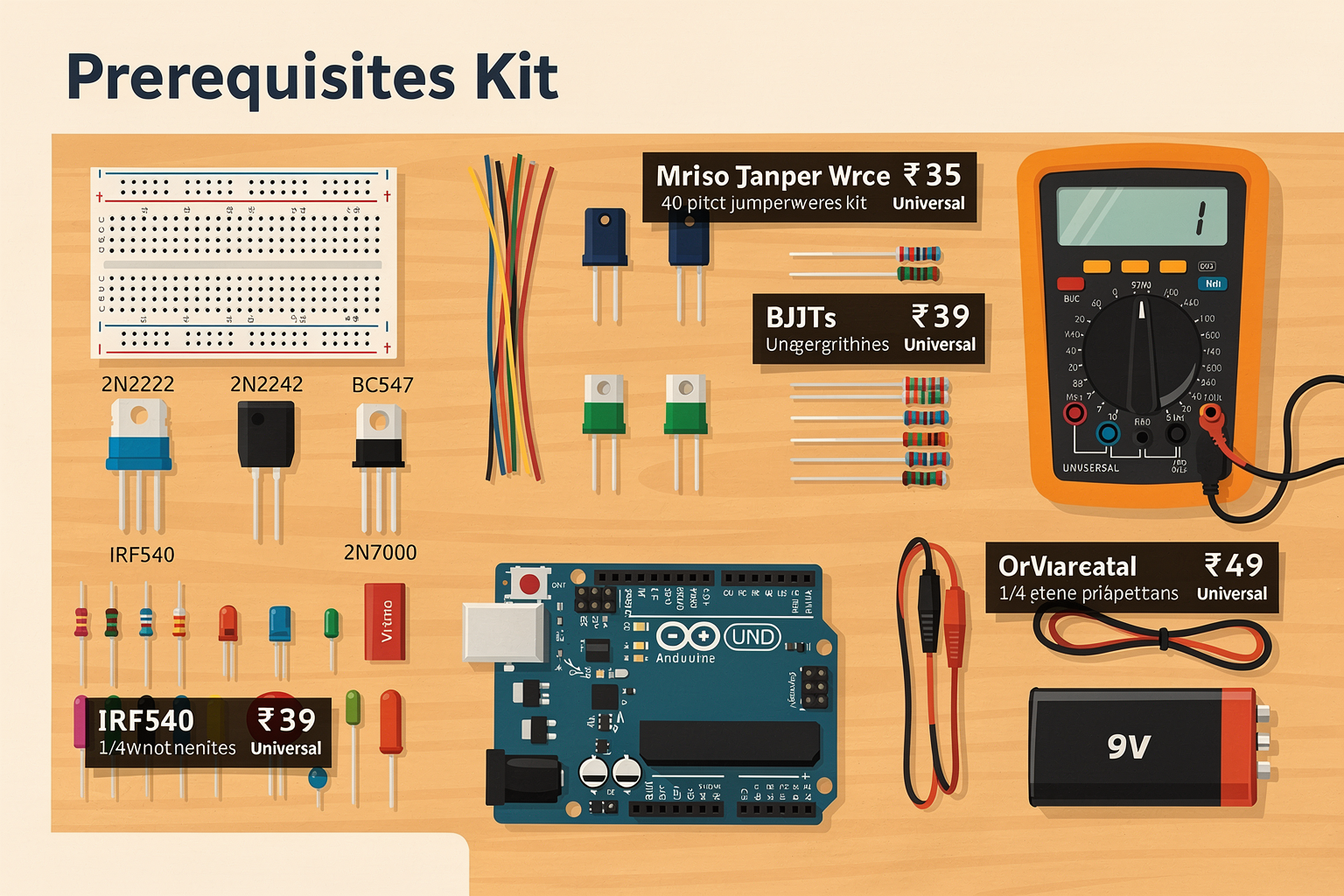
Before we dive deep into transistors, make sure you have the following components and tools. All these are readily available at your nearest electronics market in India, from SP Road in Bangalore to Lamington Road in Mumbai:
| Component | Specification | Price (₹) | Availability |
|---|---|---|---|
| Breadboard | 830-points | 120 | Universal |
| Jumper Wires | 40pcs set | 80 | Universal |
| Multimeter | Digital | 800 | Universal |
| BJT Transistors | 2N2222, BC547 | 20 each | Universal |
| MOSFETs | IRF540, 2N7000 | 15-25 each | Universal |
| Resistors | 1/4W, various values | 10 per set | Universal |
| Capacitors | Electrolytic, Ceramic | 10 per set | Universal |
| Arduino/ESP32 | Basic Kit | 850-1200 | Universal |
| Power Supply | 9V battery/adapter | 150 | Universal |
Understanding Transistors Basics

H3 What are Transistors?
Transistors are semiconductor devices that can amplify electrical signals or act as electronically controlled switches. Think of them as microscopic electronic valves - they can control the flow of current in a circuit based on a small input signal. The term "transistor" comes from "transfer resistor," highlighting their ability to control large current flows with small signals.
There are two main types of transistors that every Indian engineering student should know:
- BJT (Bipolar Junction Transistor) - Uses both electrons and holes for conduction
- MOSFET (Metal-Oxide-Semiconductor Field-Effect Transistor) - Uses only one type of charge carrier
H3 Basic Physics Behind Transistor Operation
At the heart of every transistor is the semiconductor material, typically silicon. Semiconductors have properties between conductors (like copper) and insulators (like rubber). By doping silicon with impurities, we create regions with different electrical properties:
- N-type: Doped with electrons (negative charge carriers)
- P-type: Doped with holes (positive charge carriers)
The magic happens when we combine these regions in specific patterns. For BJTs, we have NPN or PNP configurations, while MOSFETs have Drain, Source, and Gate terminals.
BJT (Bipolar Junction Transistors)
H3 Structure and Types
BJT transistors have three terminals:
- Emitter: Emits electrons (N-type in NPN)
- Base: Controls the flow of electrons
- Collector: Collects electrons (P-type in NPN)
In India, you'll commonly encounter:
- NPN transistors: 2N2222, BC547, KSC1845
- PNP transistors: 2N3906, BC557
H3 How BJT Work
In an NPN transistor, when a small current flows from base to emitter, it allows a much larger current to flow from collector to emitter. This current amplification is what makes BJTs excellent for amplification applications.
The key principle is base current control: a tiny base current (Ib) can control a much larger collector current (Ic). The relationship is: Ic = β × Ib, where β (beta) is the current gain factor.
H3 Practical BJT Circuits
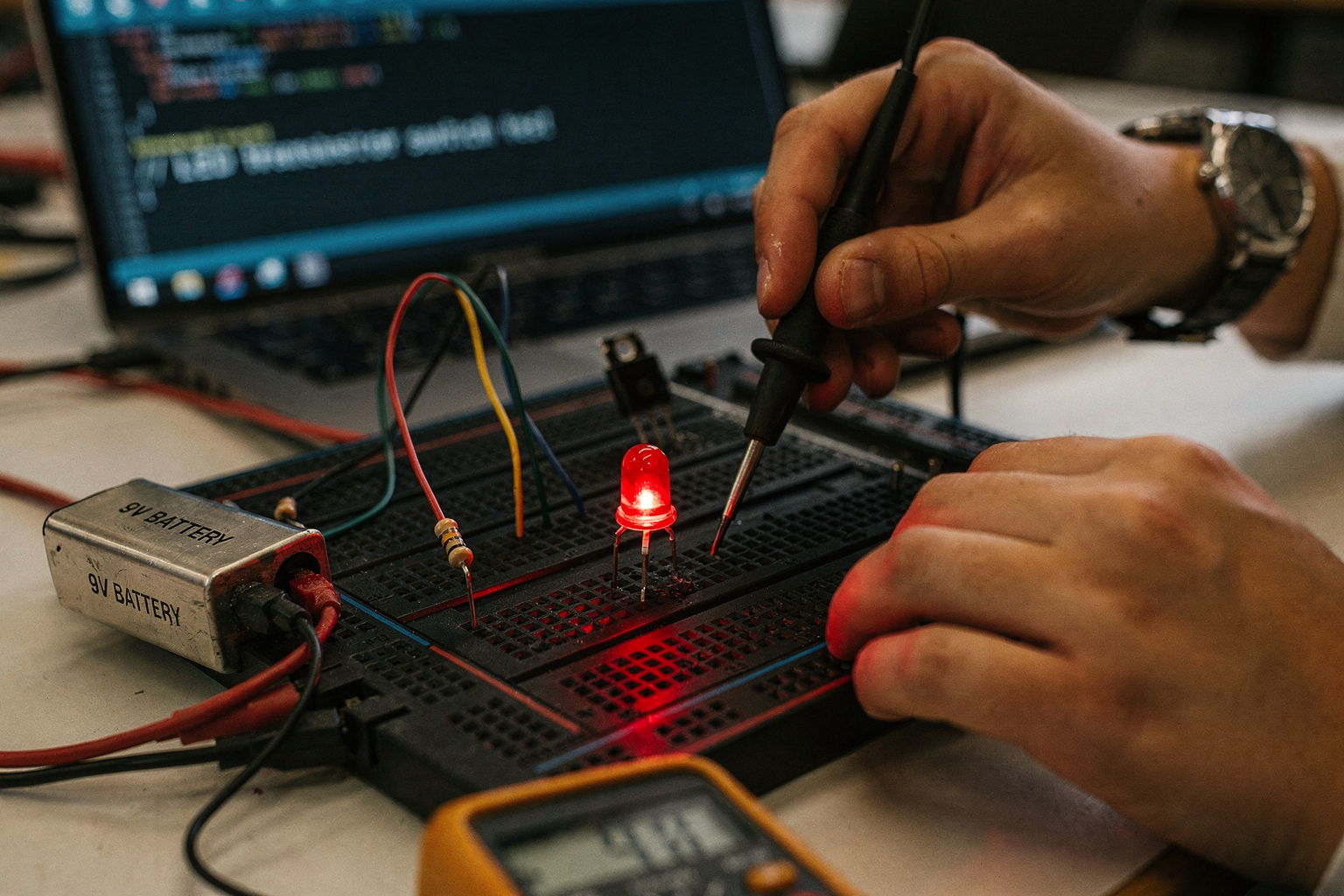
Here's a simple LED switching circuit using a BJT, perfect for beginners:
// Arduino code to control LED using BJT
const int buttonPin = 2;
const int ledPin = 13;

void setup() {
  pinMode(buttonPin, INPUT);
  pinMode(ledPin, OUTPUT);
  Serial.begin(9600);
}

void loop() {
  bool buttonState = digitalRead(buttonPin);

  if (buttonState == HIGH) {
    digitalWrite(ledPin, HIGH);
    Serial.println("LED ON - BJT conducting");
  } else {
    digitalWrite(ledPin, LOW);
    Serial.println("LED OFF - BJT off");
  }
  delay(500);
}
Practical Tip: When using BJTs as switches, always use a base resistor (typically 1kΩ to 10kΩ) to prevent excessive base current that could damage the transistor.
H3 Choosing the Right BJT for Your Project
For your DIY projects in India, consider these factors:
| Application | Recommended BJT | Price Range (₹) | Why? |
|---|---|---|---|
| Small signal switching | BC547 | 15-20 | Low cost, versatile |
| Motor control | 2N2222 | 20-25 | High current capability |
| Audio amplification | KSC1845 | 30-35 | Good frequency response |
MOSFET (Metal-Oxide-Semiconductor Field-Effect Transistors)
H3 Structure and Types
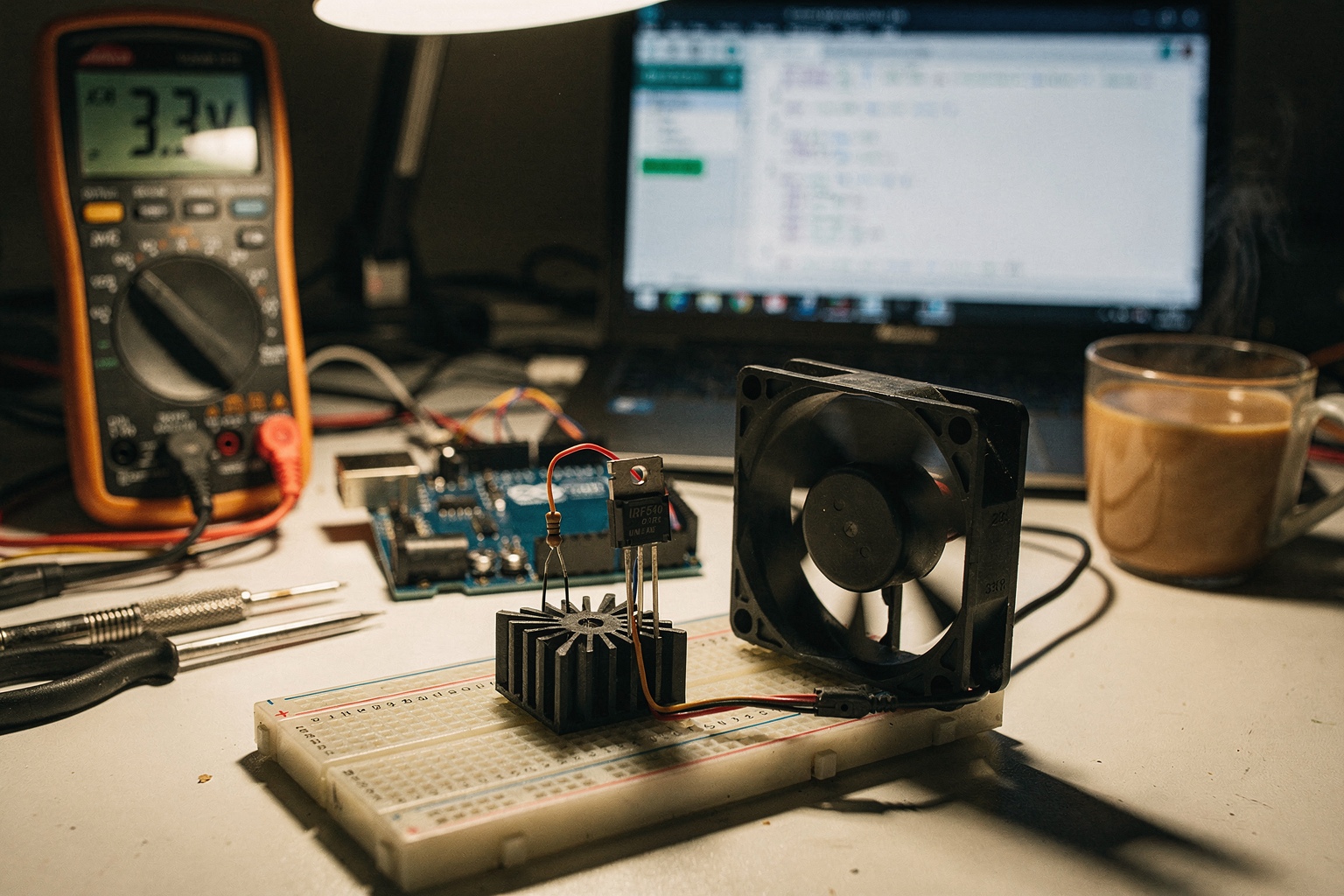
MOSFETs have four terminals (three main ones):
- Gate: Controls the channel (input)
- Source:
Ready to start building?
Explore our collection of DIY kits and components. All project components mentioned in this blog are available in our store.
Browse All Projects