

RISC-V vs Arduino: Which Microcontroller Board Should You Choose?
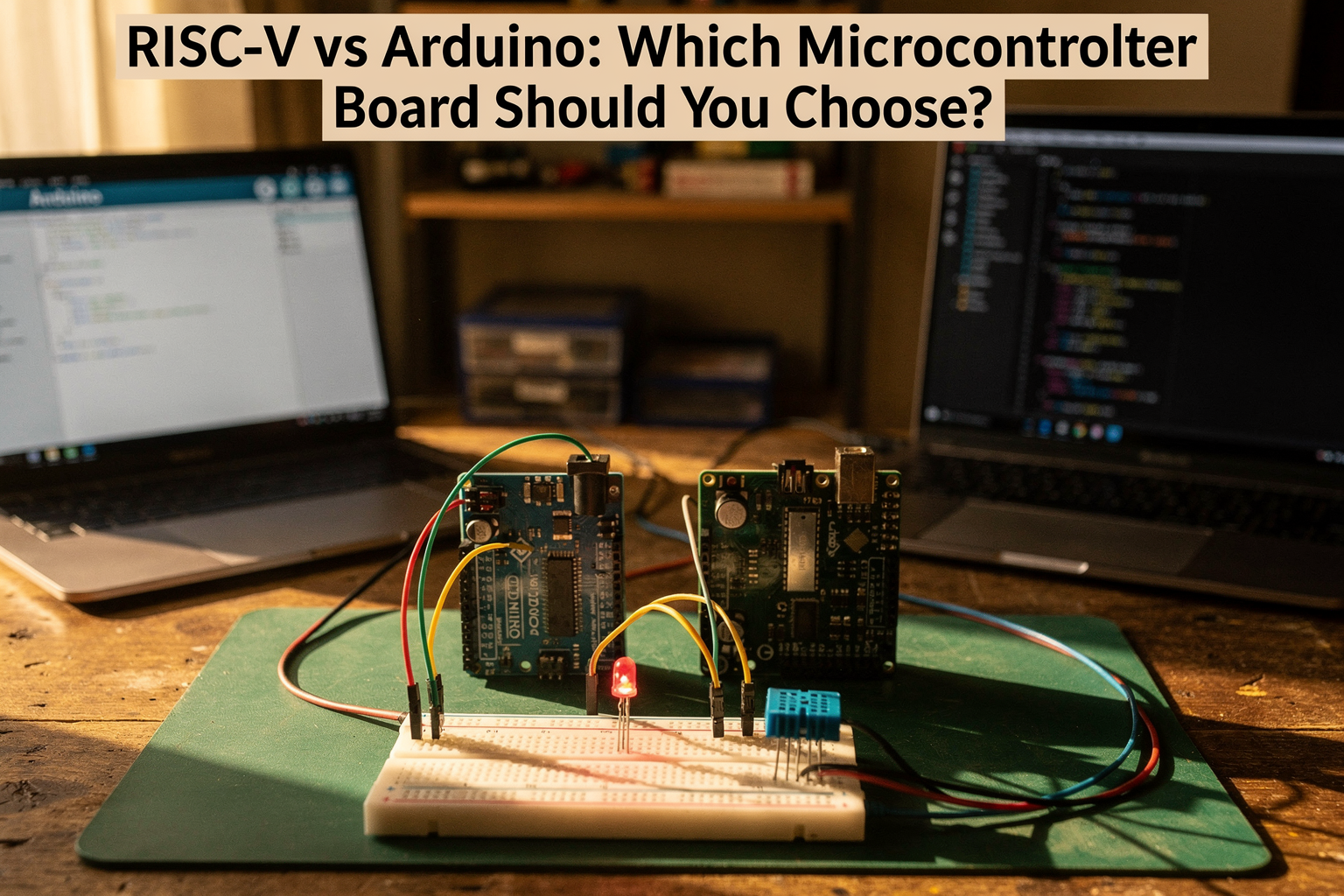
Choosing your first microcontroller board is an exciting milestone for any engineering student or DIY electronics enthusiast in India. It's the gateway to bringing your ideas to life, from a simple weather station to a complex autonomous robot. In the crowded market of development boards, two names consistently stand out: Arduino and the emerging force, RISC-V.
Arduino has been the trusted companion for beginners for over a decade, celebrated for its simplicity and massive community. On the other hand, RISC-V is an open-source revolution, promising customization, high performance, and cost-effectiveness, making it a hot topic in engineering colleges and research labs across the country.
This comprehensive guide will delve deep into the world of riscv architecture and Arduino boards. We will compare them across critical parameters, analyze their performance on real-world tasks, and provide practical code examples to help you decide which board is the perfect fit for your next project.
Understanding the Fundamentals: Arduino vs RISC-V
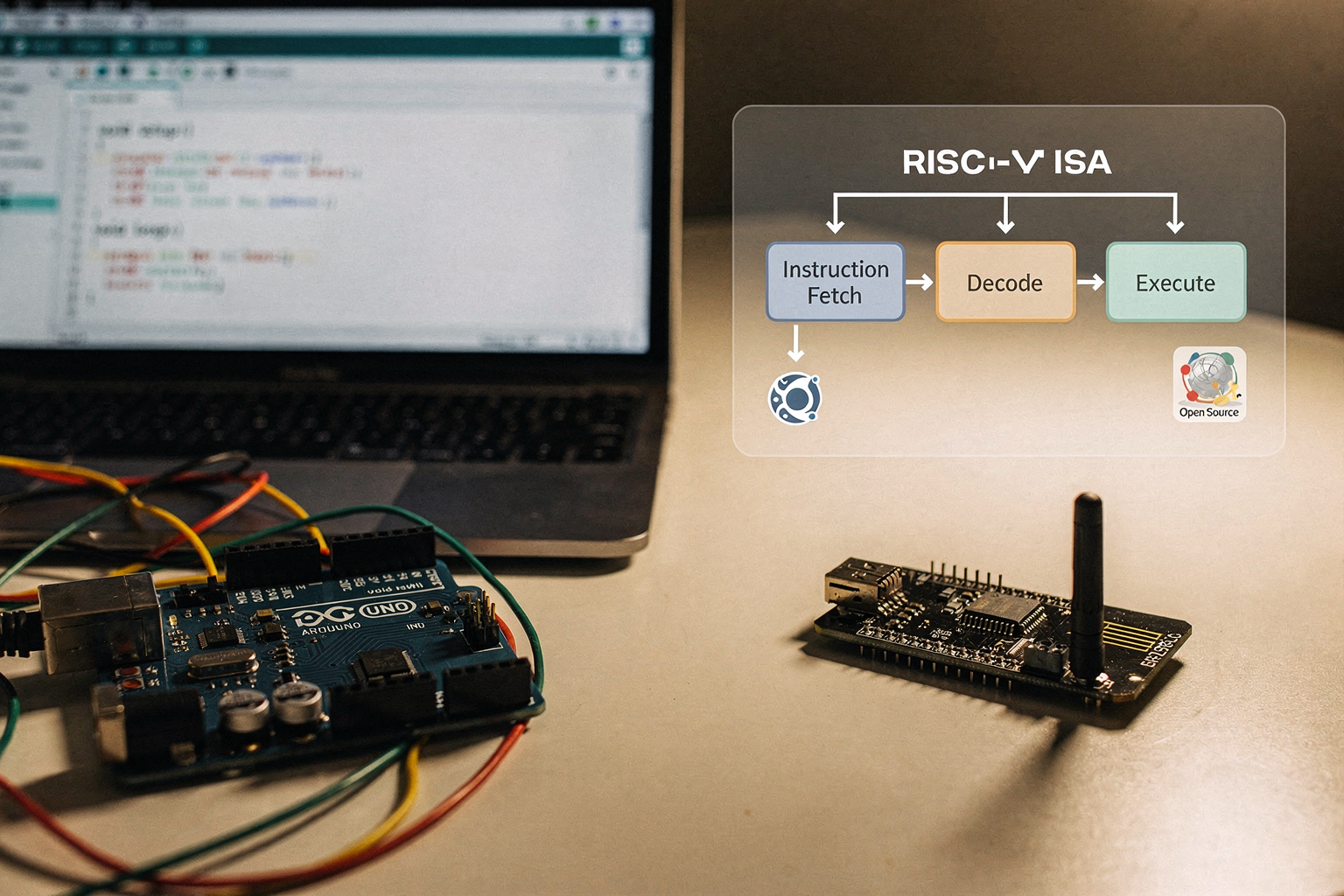
Before we jump into the comparison, it's crucial to understand what these two platforms actually are. They represent fundamentally different philosophies.
What is Arduino?
Arduino is not just a microcontroller; it's an ecosystem. At its heart is a simple, user-friendly development board (like the Uno or Nano) based on a microprocessor (traditionally an AVR, now also ARM-based). The magic of Arduino lies in two things:
- Hardware: Boards designed for ease of use, robust power regulation, and straightforward I/O.
- Software: The Arduino IDE, a simplified programming environment based on C/C++. You write code in a structured
setup()andloop()format, and the IDE handles the complex compilation and uploading process.
This combination makes it incredibly accessible for beginners who just want to focus on their project logic without getting bogged down by low-level hardware details. The vast library support means you can easily add sensors, motors, and displays with just a few lines of code.
What is RISC-V?
It's important to clarify that RISC-V is not a board. It is an open-source Instruction Set Architecture (ISA), much like ARM or x86. An ISA is the fundamental language a processor understands. The key advantage of RISC-V is that its specification is royalty-free and open for anyone to use, modify, and implement.
This means companies and developers can design their own custom RISC-V processor cores, tailoring them for specific applications like high-speed computing, low-power IoT devices, or AI at the edge. These custom cores are then placed on a board along with other necessary components like memory, Wi-Fi modules, and peripherals.
The rise of RISC-V has led to a growing number of affordable and powerful development boards in the Indian market, built around cores like the RISC-V RV32EC (a 32-bit core with single-precision floating-point) or the more advanced RV64GC.
Head-to-Head Comparison: Key Features at a Glance
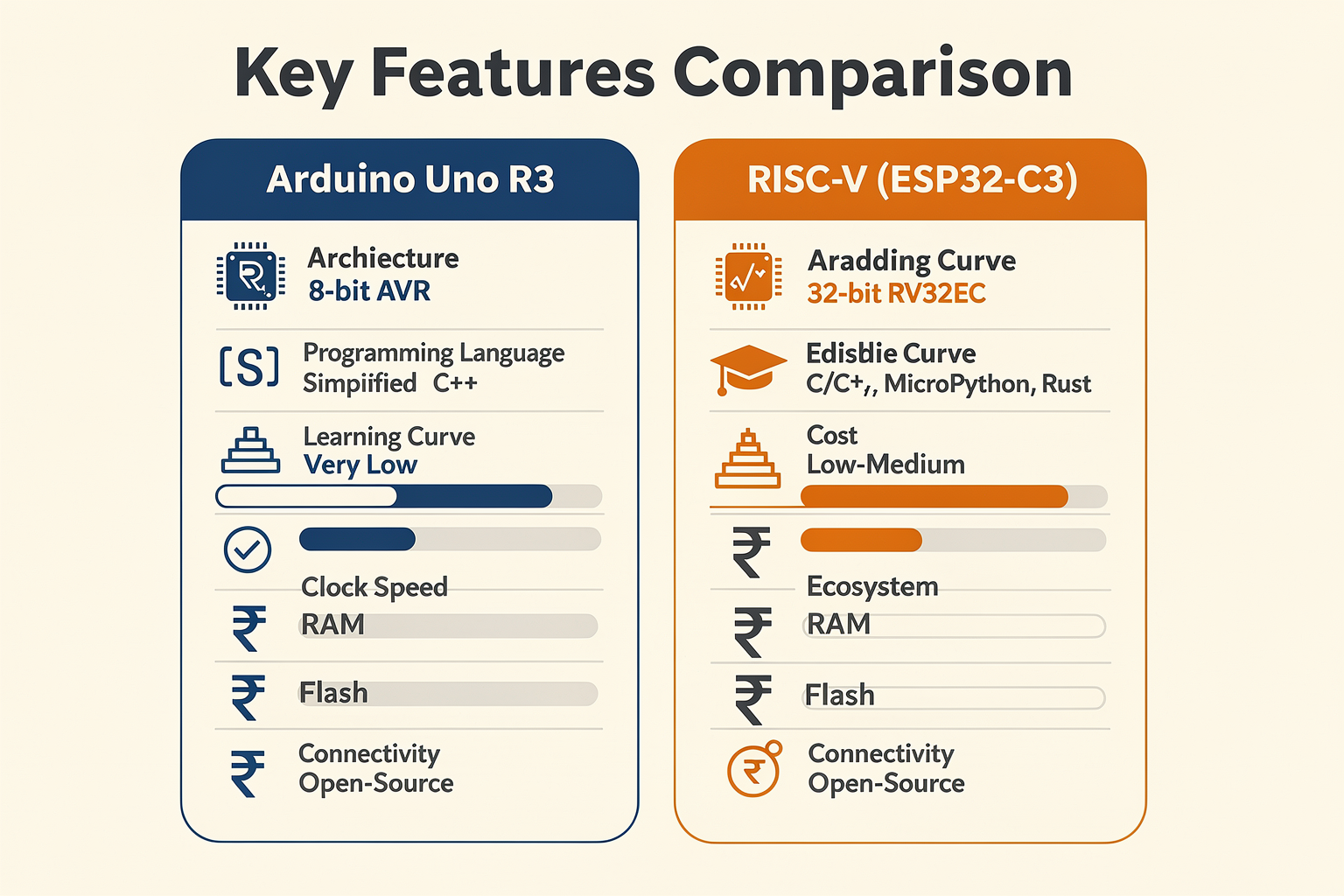
Let's put the two platforms side-by-side to see how they stack up on the most important features for a student or hobbyist.
| Feature | Arduino (e.g., Uno R3) | RISC-V Board (e.g., ESP32-C3) |
|---|---|---|
| Architecture | Primarily 8-bit AVR (ATmega328P) | 32-bit RISC-V (RV32EC) |
| Programming Language | Simplified C++ (Arduino Language) | C/C++, MicroPython, Rust |
| Learning Curve | Very Low. Ideal for absolute beginners. | Low to Medium. Depends on the board and tools. |
| Cost of Board | ₹300 - ₹600 | ₹450 - ₹800+ |
| Ecosystem & Community | Extremely Large and Mature. Tons of tutorials, forums, and libraries. | Growing Rapidly. Good community support, but less extensive than Arduino. |
| Customization | Low. You are stuck with the fixed hardware. | High. You can choose from various RISC-V cores with different features. |
| Performance | Low. 16 MHz, 2KB RAM, 32KB Flash. | High. 160-240 MHz, 400KB RAM, 4MB Flash. |
| Power Consumption | Moderate. Good low-power modes. | Very Low. Designed for ultra-low-power IoT applications. |
| Availability in India | Widely available at all major electronics stores and online. | Increasingly available online (Amazon, Robu.in, and TecnoMate). |
Deep Dive: Performance and Power Analysis
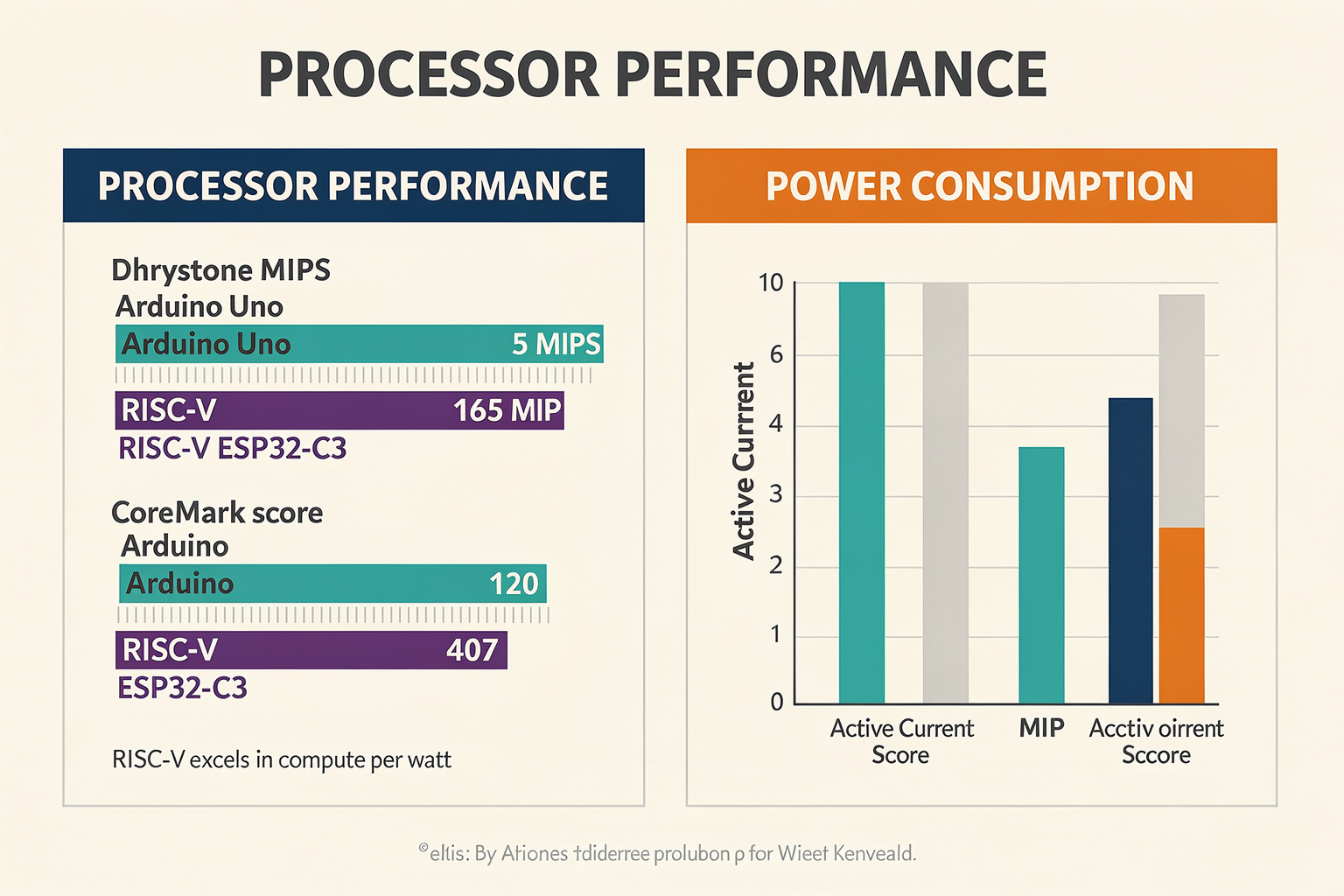
Theory is one thing, but real-world performance is what matters for your projects.
Raw Processing Power
Let's compare the popular Arduino Uno (ATmega328P) with a modern RISC-V board like the ESP32-C3.
-
Arduino Uno:
- Clock Speed: 16 MHz
- Architecture: 8-bit
- RAM: 2 KB
- Flash: 32 KB
-
ESP32-C3 (RISC-V Board):
- Clock Speed: 160-240 MHz (it's a dual-core!)
- Architecture: 32-bit RISC-V
- RAM: 400 KB
- Flash: 4 MB (plus external PSRAM)
What does this mean in practice?
The performance gap is enormous. A task that would take the Arduino Uno several seconds (e.g., processing a large array of sensor data) would take the ESP32-C3 mere milliseconds. This enables you to do things on a RISC-V board that are simply impossible on a traditional Arduino:
- Run an Operating System: You can run a lightweight OS like FreeRTOS on a RISC-V board, but not on an Arduino Uno.
- Handle Complex Protocols: Implementing complex networking stacks like MQTT or full TCP/IP libraries is much more feasible.
- AI at the Edge: You can run TinyML models (like simple gesture recognition) directly on a RISC-V board, whereas an Arduino would struggle immensely.
Power Efficiency
For many IoT applications, battery life is paramount. RISC-V architecture was designed from the ground up with power efficiency in mind.
- Deep Sleep: RISC-V chips often have exceptionally low deep sleep current consumption, sometimes in the microampere (µA) range. The ESP32-C3, for example, can draw as little as 20 µA in deep sleep, allowing a coin-cell battery to last for months or even years.
- Dynamic Power Gating: The open-source nature of RISC-V allows designers to implement fine-grained power gating, turning off unused parts of the processor to save energy.
While Arduino boards also have low-power sleep modes, dedicated RISC-V boards for IoT generally offer superior power management, making them the superior choice for remote, battery-powered sensor nodes.
Programming and Development Experience
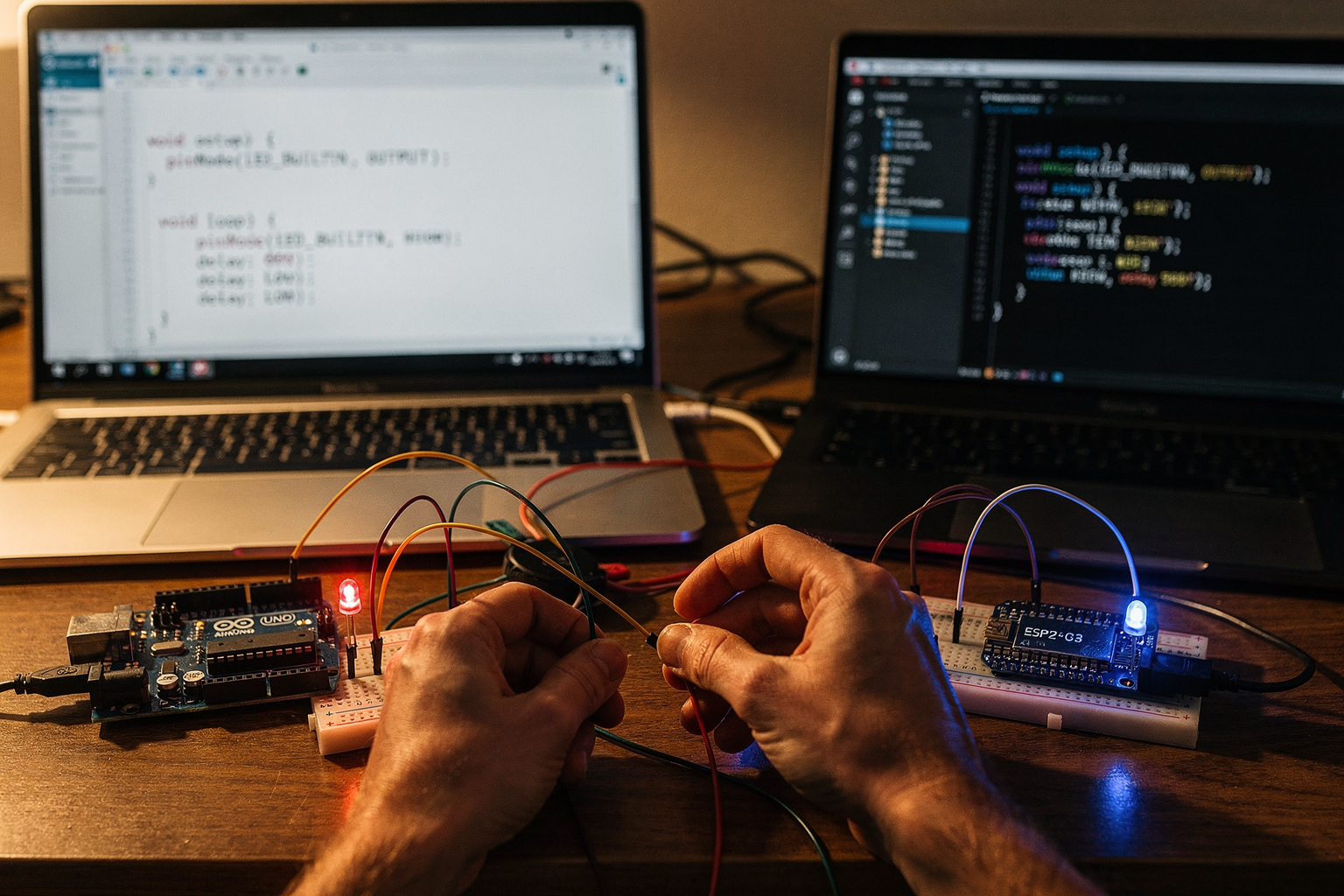
The ease of getting started is often the deciding factor for students.
The Arduino IDE Advantage
The Arduino IDE is famous for its simplicity. Here's the classic "Hello World" of embedded systems: blinking an LED.
Code Snippet (Arduino C++):
/*
  Blink
  Turns an LED on for one second, then off for one second, repeatedly.
*/

// The setup() function runs once when you press reset or power the board on:
void setup() {
  // Initialize the digital pin LED_BUILTIN as an output.
Ready to start building?
Explore our collection of DIY kits and components. All project components mentioned in this blog are available in our store.
Browse All Projects