

ToF Sensors vs Ultrasonic: Distance Measurement for Arduino
Introduction
When you're building your latest Arduino project, choosing the right distance sensor can make or break your application. As Indian engineering students and DIY enthusiasts, we often face this dilemma - should we go with the tried-and-tested ultrasonic sensors or explore the newer ToF (Time of Flight) technology? The choice between these sensors isn't just about cost; it's about accuracy, reliability, and the specific requirements of your project.
In this comprehensive guide, we'll dive deep into the world of distance measurement sensors, comparing ToF sensors against traditional ultrasonic sensors with practical examples, real-world applications, and pricing details relevant to the Indian market. By the end of this article, you'll be equipped with the knowledge to make an informed decision for your next project.
Feature Comparison: At a Glance
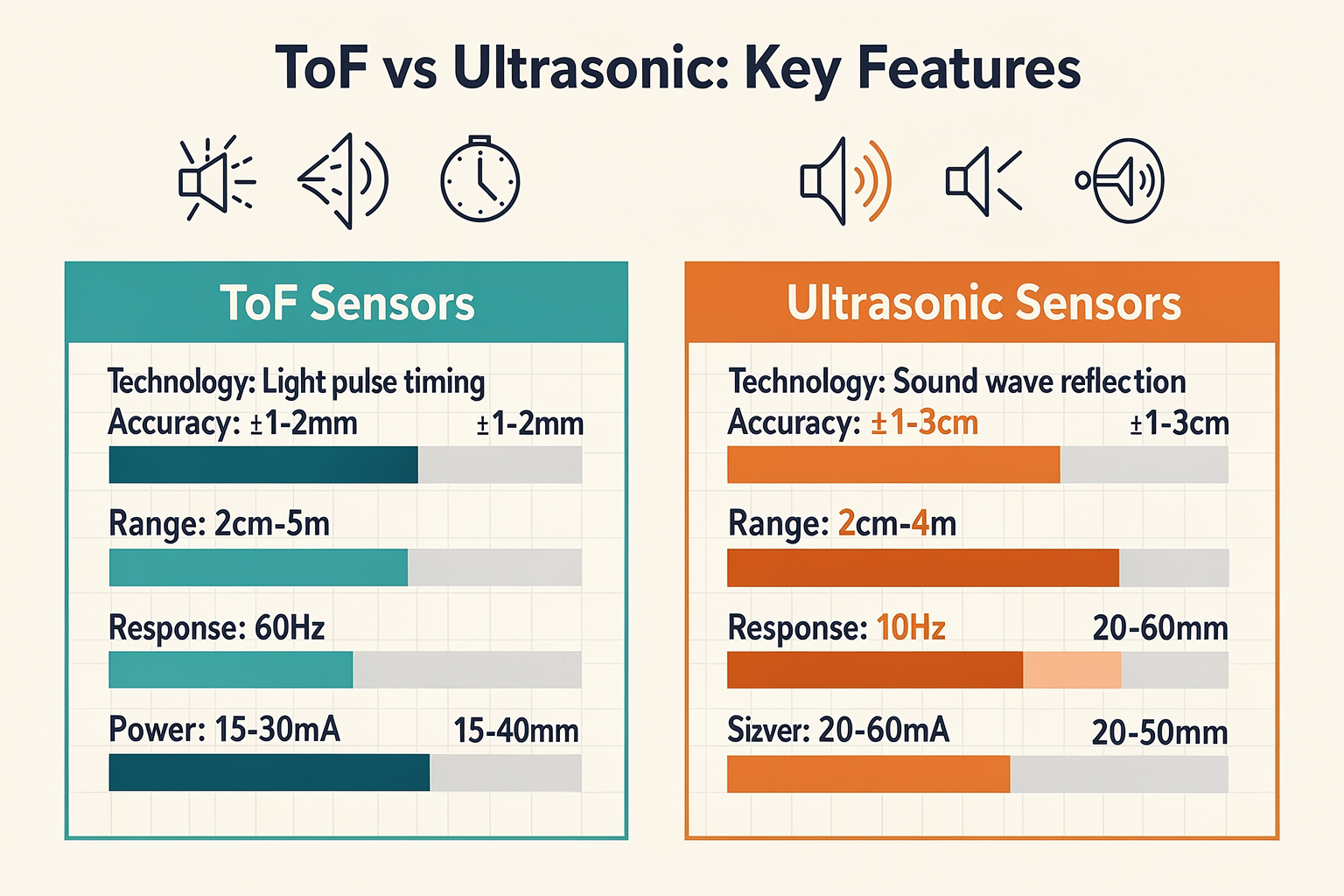
Let's start with a quick overview of the key differences between ToF and ultrasonic sensors to help you understand their fundamental characteristics.
| Feature | ToF Sensors | Ultrasonic Sensors |
|---|---|---|
| Technology | Light pulse timing | Sound wave reflection |
| Accuracy | ±1-2mm | ±1-3cm |
| Range | 2cm - 5m | 2cm - 4m |
| Response Time | 60Hz | 10Hz |
| Power Consumption | 15-30mA | 20-60mA |
| Size | 15mm - 40mm | 20mm - 50mm |
This initial comparison shows that ToF sensors generally offer superior accuracy and faster response times, but there's much more to consider before making your choice.
Understanding the Technology: How They Work
ToF (Time of Flight) Technology
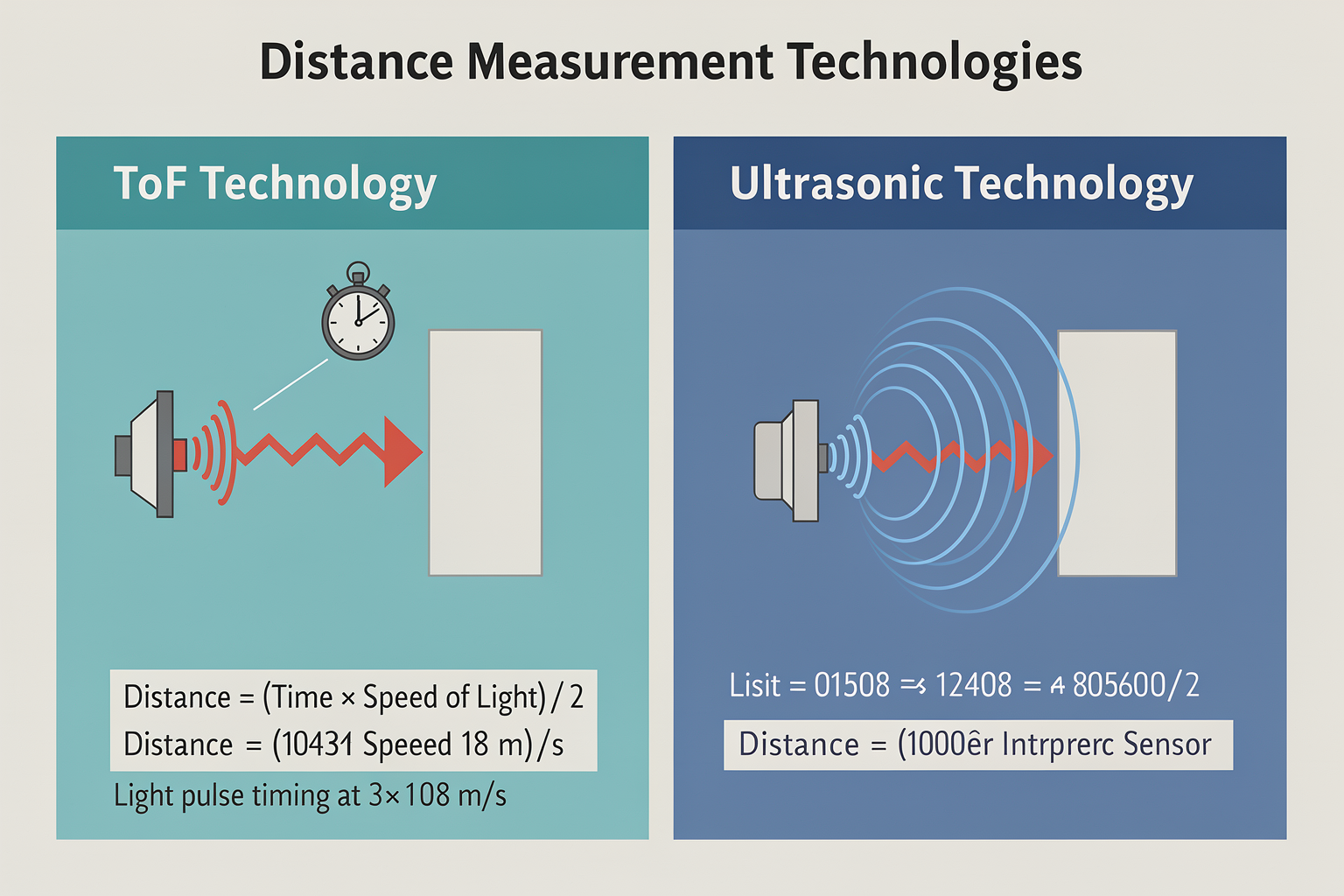
ToF sensors work by emitting a light pulse (typically infrared) and measuring the time it takes for the light to travel to an object and back. The formula is simple:
Distance = (Time × Speed of Light) / 2
Most modern ToF sensors use multiple measurement points (pixels) to provide not just distance but also environmental data like surface properties and ambient light conditions.
Ultrasonic Technology
Ultrasonic sensors emit high-frequency sound waves (typically 40kHz) and measure the time for the echo to return. The principle is similar:
Distance = (Time × Speed of Sound) / 2
The speed of sound varies with temperature (approximately 343 m/s at 20°C), which can affect accuracy.
Detailed Technical Comparison
Let's dive deeper into the technical specifications and real-world performance metrics that matter to engineering students.
Accuracy and Precision
ToF Sensors:
- Typical accuracy: ±1-2mm
- Resolution: Can detect individual millimeters
- Affected by: Surface reflectivity, ambient light
- Best for: Precise distance measurements, 3D scanning
Ultrasonic Sensors:
- Typical accuracy: ±1-3cm
- Resolution: Limited by sound wave characteristics
- Affected by: Temperature, humidity, surface texture
- Best for: General distance detection, object presence
Range and Performance
The effective range of each sensor type varies significantly based on environmental conditions and specific model selection.
| Sensor Type | Min Range | Max Range | Beam Angle | Optimal Surface |
|---|---|---|---|---|
| VL53L0X ToF | 10cm | 2m | 24° | Dark surfaces |
| VL6180X ToF | 20cm | 5m | 15° | Any surface |
| HC-SR04 | 2cm | 400cm | 15° | Any surface |
| US-100 | 2cm | 500cm | 15° | Any surface |
Environmental Factors
ToF sensors are sensitive to:
- Direct sunlight (IR interference)
- Highly reflective surfaces
- Very dark or black surfaces
- Transparent materials
Ultrasonic sensors are affected by:
- Temperature changes (speed of sound variation)
- Wind and air currents
- Soft materials that absorb sound
- Background noise
Use Cases for Indian Engineering Students
Robotics and Automation
For robotics projects, the choice often depends on the specific application:
ToF sensors excel in:
- Obstacle avoidance with precise distance calculation
- Line following with height detection
- Autonomous navigation systems
- 3D mapping and SLAM algorithms
Ultrasonic sensors work well for:
- Basic obstacle detection
- Parking assistance systems
- Distance measurement in larger spaces
- Safety shutdown mechanisms
IoT and Smart Home Projects
When implementing IoT solutions, consider these scenarios:
| Application | Recommended Sensor | Reason |
|---|---|---|
| Smart parking | Ultrasonic | Cost-effective, good range |
| Water level monitoring | ToF | Precise measurement |
| Door automation | Ultrasonic | Simple implementation |
| Room occupancy | ToF | Better accuracy for counting |
Industrial Automation
For industrial applications, where reliability is crucial:
// Example: Industrial object counting with ToF sensor
#include <VL6180X.h>
VL6180X sensor;

void setup() {
  Serial.begin(9600);
  sensor.init();
  sensor.setAddress(0x39);
}

void loop() {
  VL6180X_RangingMeasurementData_t measure;
  VL6180X_DataInit(&measure);

  sensor.readRangeSingleShot(SINGLE_SHOT_MODE, &measure);

  if (measure.range_mm < 1000) { // Object detected within 1m
    Serial.println("Object detected!");
    delay(100); // Debounce
  }
}
Pricing Comparison: Indian Market Analysis
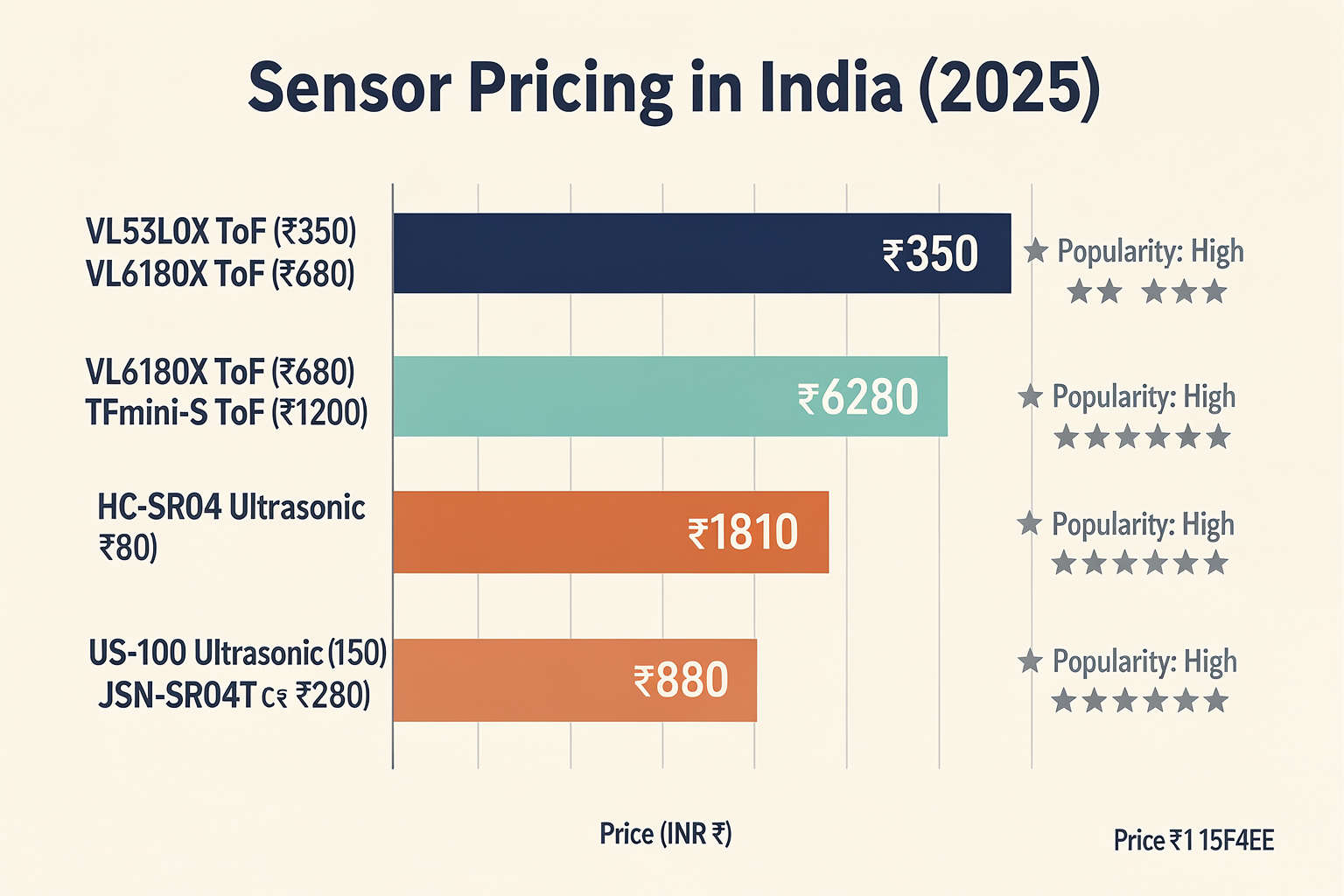
Here's a realistic pricing guide for components available on the Indian market through platforms like Amazon, Robu.in, and local electronics shops:
| Component | Model | Price (₹) | Availability |
|---|---|---|---|
| ToF Sensor | VL53L0X | 450 | High |
| ToF Sensor | VL6180X | 680 | Medium |
| ToF Sensor | TFmini-S | 1200 | High |
| Ultrasonic | HC-SR04 | 80 | Very High |
| Ultrasonic | US-100 | 150 | High |
| Ultrasonic | JSN-SR04T | 280 | Medium |
Value Analysis:
- For hobby projects: HC-SR04 offers excellent value
- For precision applications: VL53L0X provides the best cost-to-performance ratio
- For industrial use: TFmini-S offers advanced features at competitive pricing
Pros and Cons Analysis
ToF Sensors: Advantages and Limitations
| Advantages | Limitations |
|---|---|
| High accuracy (±1-2mm) | Higher cost |
| Fast response time (60Hz) | Sensitive to bright light |
| Small form factor | Limited range on reflective surfaces |
| Multiple measurement points | Requires careful calibration |
| Better environmental resistance | More complex interfacing |
Ultrasonic Sensors: Advantages and Limitations
| Advantages | Limitations |
|---|---|
| Low cost | Lower accuracy (±1-3cm) |
| Simple interfacing | Slower response (10Hz) |
| Works with any surface | Affected by temperature |
| Good long range | Large beam spread |
| Widely available | Multiple sensors can interfere |
Ready to start building?
Explore our collection of DIY kits and components. All project components mentioned in this blog are available in our store.
Browse All Projects