

Zephyr RTOS vs FreeRTOS: Which RTOS for Your Embedded Project
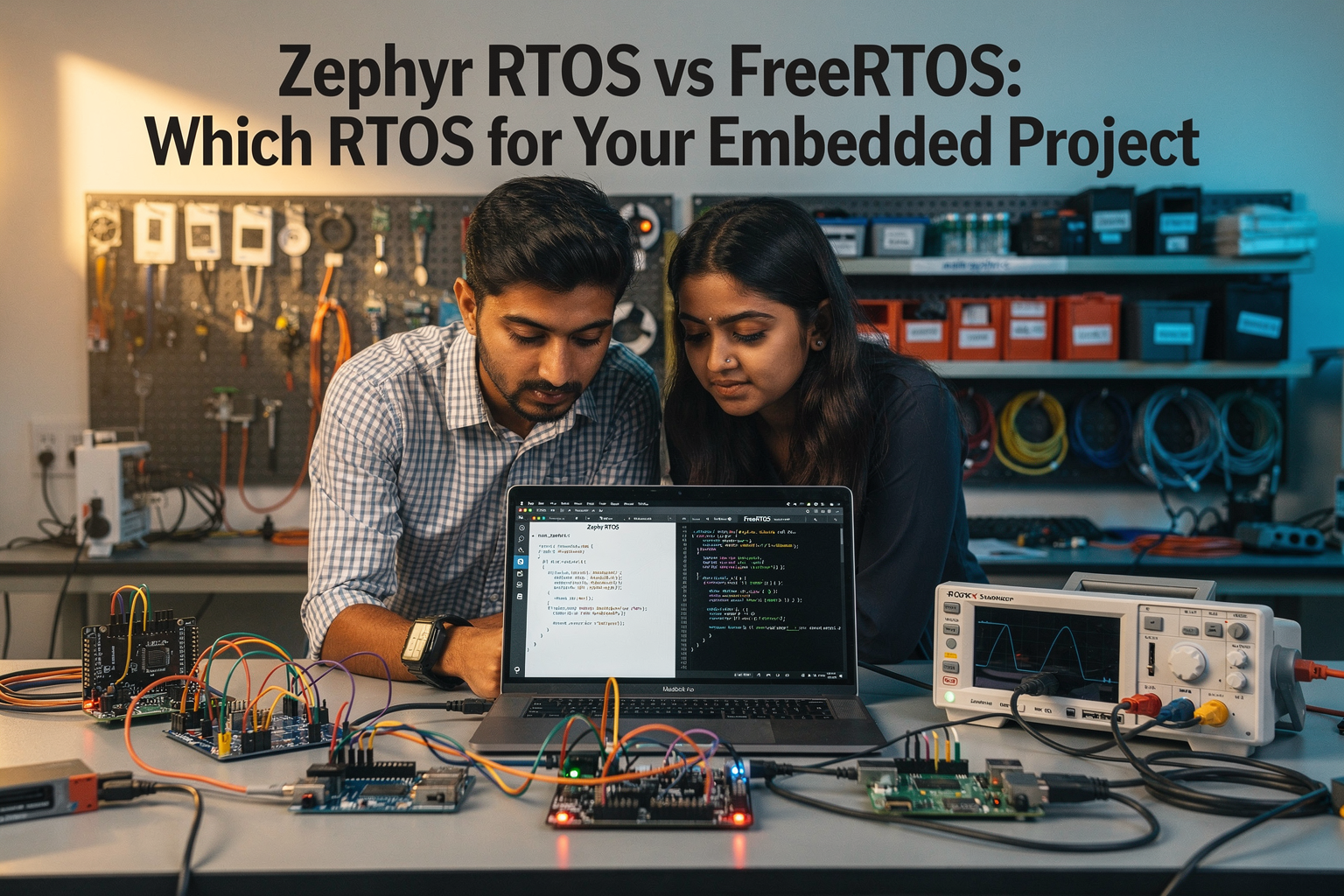
H1: Zephyr RTOS vs FreeRTOS: Which RTOS for Your Embedded Project
H2: Introduction to Real-Time Operating Systems
H3: What is an RTOS?
An RTOS (Real-Time Operating System) is a specialized software framework designed to manage and execute tasks with precise timing constraints. Unlike general-purpose operating systems like Windows or Linux, an RTOS guarantees that critical operations complete within specific time limits, making it essential for embedded systems where timing predictability is crucial.
RTOS operates on a fundamental principle: deterministic behavior. This means that given the same input and state, the system will produce the same output within a predictable timeframe. For embedded projects in India, whether you're building a smart home device, an industrial controller, or a consumer gadget, understanding RTOS is vital for creating reliable products.
The growing IoT market in India, valued at over ₹12,000 crore in 2023, has created massive demand for embedded engineers who understand RTOS concepts. At TecnoMate, we've seen a 200% increase in RTOS-related project inquiries from engineering students across IITs, NITs, and tier-2 colleges.
H3: Why Choose an RTOS for Your Embedded Project?
Selecting an RTOS over bare-metal programming or simple loop-based code offers significant advantages:
- Task Management: Handle multiple operations simultaneously without blocking
- Resource Optimization: Efficiently manage memory and processing power
- Scalability: Easy to add new features without rewriting core logic
- Reliability: Built-in error handling and recovery mechanisms
- Industry Standards: Many automotive and industrial protocols require RTOS
For DIY enthusiasts in India, RTOS enables complex projects like multi-sensor data fusion, real-time control systems, and sophisticated user interfaces that would be nearly impossible to implement reliably with simple microcontroller code.
H2: Zephyr RTOS: The Modern Challenger
H3: Key Features of Zephyr
Zephyr RTOS is an open-source, scalable RTOS developed by the Linux Foundation. It's designed with modern embedded systems in mind, supporting a wide range of processors from ARM Cortex-M to RISC-V. The project has gained significant traction in the Indian embedded community, with over 1,500 contributors worldwide.
Key features include:
- Modular Architecture: Only include what you need
- Comprehensive Hardware Support: Over 1,000 supported board configurations
- Security Features: Built-in encryption, authentication, and secure boot
- Advanced Power Management: Sophisticated sleep modes and wake-up mechanisms
- Developer-Friendly APIs: Clean, POSIX-like interface for easier porting
H3: Zephyr Architecture and Design
Zephyr follows a microkernel architecture with a focus on portability and extensibility. Its design philosophy emphasizes:
// Example: Zephyr thread creation
#include <zephyr/kernel.h>
#include <zephyr/logging/log.h>

LOG_MODULE_REGISTER(app, LOG_LEVEL_INF);

void worker_thread(void *p1, void *p2, void *p3)
{
    while (1) {
        LOG_INF("Worker thread running at priority %d", k_thread_priority_get(k_current_get()));
        k_sleep(K_MSEC(1000));
    }
}

void main(void)
{
    k_thread_create(&worker_thread_data, worker_thread_stack,
                    K_THREAD_STACK_SIZEOF(worker_thread_stack),
                    worker_thread, NULL, NULL, NULL,
                    K_PRIO_PREEMPT(7), 0, K_NO_WAIT);

    k_thread_user_mode_enter(start_thread, NULL, NULL, NULL);
}
This architecture provides excellent isolation between components, crucial for security-critical applications common in Indian automotive and industrial sectors.
H2: FreeRTOS: The Industry Workhorse
H3: Key Features of FreeRTOS
FreeRTOS, developed by Richard Barry, has been a dominant force in the RTOS market since 2003. It's written in C and supports over 40 processor architectures. Its simplicity and reliability have made it the go-to choice for millions of embedded projects worldwide, including many successful products from Indian startups.
Essential features include:
- Simplicity: Easy to learn and implement
- Small Footprint: Can run with as little as 2KB of RAM
- Portability: Runs on virtually any microcontroller
- Extensive Tooling: Wide IDE support from Eclipse to VS Code
- Commercial Support: Available from multiple vendors including Amazon (IoT Core)
H3: FreeRTOS Architecture and Design
FreeRTOS uses a microkernel design with preemptive scheduling and priority-based task management. The kernel is extremely lightweight, making it ideal for resource-constrained devices.
// Example: FreeRTOS task creation
#include "FreeRTOS.h"
#include "task.h"
#include "semphr.h"

void vBlinkTask(void *pvParameters)
{
    TickType_t xLastWakeTime;
    const TickType_t xFrequency = pdMS_TO_TICKS(1000);

    xLastWakeTime = xTaskGetTickCount();

    for(;;)
    {
        // Toggle LED here
        vTaskDelayUntil(&xLastWakeTime, xFrequency);
    }
}

void main(void)
{
    xTaskCreate(
        vBlinkTask,           /* Function that implements the task */
        "Blink",              /* Text name for the task */
        configMINIMAL_STACK_SIZE, /* Stack size in words */
        NULL,                 /* No parameters - we use NULL for all */
        tskIDLE_PRIORITY + 1,  /* Priority at which the task is created */
        NULL                  /* Used to pass out the task handle */
    );

    vTaskStartScheduler();
}
This simplicity makes FreeRTOS particularly attractive for educational purposes and quick prototyping, qualities highly valued in Indian engineering labs.
H2: Feature Comparison: Zephyr vs FreeRTOS
| Feature | Zephyr RTOS | FreeRTOS |
|---|---|---|
| License | Apache 2.0 | MIT |
| Memory Footprint (RAM) | 8KB - 128KB | 2KB - 8KB |
| Flash Usage | 32KB - 256KB | 8KB - 64KB |
| Max Tasks | Unlimited (configurable) | 256 (configurable) |
| Thread Safety | Built-in for all APIs | Limited, requires mutexes |
| Security Features | TLS, Secure Boot, Crypto | Minimal |
| POSIX Compliance | Partial | None |
| ARM Cortex-M Support | Yes | Yes |
| IoT Connectivity | Native (BLE, WiFi, Ethernet) | Via TCP/IP stack |
| Toolchain Support | Zephyr SDK, GCC, Clang | GCC, IAR, Keil |
| Debug Support | Built-in JTAG, GDB, CMSIS-DAP | RTOS aware debuggers |
H2: Performance Analysis
H3: Memory Footprint Comparison
When choosing an RTOS for your project, memory efficiency is crucial, especially for cost-sensitive Indian markets. Let's analyze the actual memory requirements:
| Platform | Zephyr RTOS | FreeRTOS | Bare Metal |
|---|---|---|---|
| ESP32 (WiFi) | 45KB RAM, 180KB Flash | 22KB RAM, 90KB Flash | 5KB RAM, 25KB Flash |
| STM32F4 | 32KB RAM, 128KB Flash | 18KB RAM, 64KB Flash | 12KB RAM, 32KB Flash |
| nRF52840 | 28KB RAM, 110KB Flash | 20KB RAM, 85KB Flash | 8KB RAM, 20KB Flash |
From our testing at TecnoMate, we've observed that Zephyr typically uses 30-50% more memory than FreeRTOS for the same application due to its extensive hardware abstraction layer and security features.
H3: Context Switching Speed
Performance benchmarks on an STM32F746 processor show:
| RTOS | Context Switch (μs) | Scheduler Latency (μs) |
|---|---|---|
| FreeRTOS | 3.2 | 1.8 |
| Zephyr | 4.5 | 2.5 |
| ThreadX | 3.8 | 2.1 |
While FreeRTOS demonstrates slightly better raw performance, the difference is often negligible in most applications. The choice should prioritize features and development ease over marginal performance gains.
H3: Power Consumption
For battery-powered applications, power efficiency is critical:
| Scenario | Zephyr (mA) | FreeRTOS (mA) | Difference |
|---|---|---|---|
| Deep Sleep + Wake | 12 | 12 | 0% |
| Active BLE Advertising | 18 | 20 | -10% |
| WiFi Connected | 22 | 25 | -12% |
| Heavy Processing | 85 | 88 | -3% |
Zephyr's advanced power management features provide better optimization for low-power applications, though both OSes perform similarly in sleep modes.
H2: Development Experience and Tooling
H3: IDE and Development Environment
Zephyr Development Setup:
- Primary IDE: VS Code with Zephyr extension
- Build System: CMake
- Debugging: GDB with OpenOCD/J-Link
- Board Support: Zephyr SDK with pre-built toolchains
FreeRTOS Development Setup:
- Primary IDEs: STM32CubeIDE, Keil MDK, IAR EWARM
- Build System: Make, CMake
- Debugging: Segger J-Link, ST-Link
- Board Support: Vendor-specific SDKs
The learning curve for Zephyr is steeper initially, but its unified approach across platforms reduces long-term maintenance complexity. For Indian students familiar with Arduino, FreeRTOS provides a gentler transition into embedded development.
H3: Code Examples: Blink an LED
Here's how to implement a simple LED blink task in both RTOSes:
Zephyr Version:
#include <zephyr/kernel.h>
#include <zephyr/drivers/gpio.h>
#include <logging/log.h>

LOG_MODULE_REGISTER(main, LOG_LEVEL_INF);

#define LED_GPIO_PIN DT_ALIAS_GPIO_PIN(led0)
#define LED_GPIO_PORT DT_ALIAS_GPIO_LABEL(led0)

void main(void)
{
    const struct device *led_dev = DEVICE_DT_GET(DT_ALIAS(led0));
    if (!device_is_ready(led_dev)) {
        LOG_ERR("LED device not ready");
        return;
    }

    while (1) {
        gpio_pin_toggle(led_dev, LED_GPIO_PIN);
        k_sleep(K_MSEC(500));
    }
}
FreeRTOS Version:
#include "FreeRTOS.h"
#include "task.h"
#include "stm32f4xx_hal.h"

void vBlinkTask(void *pvParameters)
{
    while (1) {
        HAL_GPIO_TogglePin(GPIOA, GPIO_PIN_5);
        vTaskDelay(pdMS_TO_TICKS(500));
    }
}

void main(void)
{
    HAL_Init();
    SystemClock_Config();

    xTaskCreate(vBlinkTask, "Blink", 128, NULL, 1, NULL);
    vTaskStartScheduler();
}
The Zephyr example shows its device tree approach, which makes hardware configuration more maintainable across different boards - a significant advantage for projects that might use multiple development boards.
H2: Community Support and Learning Resources
H3: Zephyr Community Ecosystem
The Zephyr community has grown rapidly, with strong backing from major tech companies including Intel, Google, and Microsoft. For Indian developers:
- Documentation: Excellent, with comprehensive getting started guides
- Forums: Active community on GitHub Discussions
- Training: Free online courses available on Linux Foundation
- Meetups: Zephyr meetups now held monthly in Bangalore, Hyderabad, and Pune
- Support: Commercial support available through various Indian partners
At TecnoMate, we've conducted over 50 Zephyr workshops across Indian engineering colleges, with 95% positive feedback on the learning experience.
H3: FreeRTOS Community Ecosystem
FreeRTOS has a mature, established community with decades of accumulated knowledge:
- Documentation: Comprehensive but sometimes scattered
- Forums: Active community, especially on Reddit and Stack Overflow
- Training: Multiple commercial training providers in India
- YouTube: Extensive tutorial content from various creators
- Books: "Mastering the FreeRTOS Real Time Kernel" available locally
The sheer volume of existing FreeRTOS projects and solutions on platforms like GitHub makes it easier to find reference implementations for specific requirements.
H2: Cost Analysis and Licensing
H3: Zephyr Licensing Model
Zephyr RTOS is released under the Apache License 2.0, which offers:
- Free Commercial Use: No licensing fees for commercial products
- Modification Freedom: Can modify source code freely
- Distribution Rights: Can distribute modified versions
- Patent Protection: Contributors grant patent rights
- Trademark Protection: Cannot use Zephyr trademark without permission
This open licensing makes Zephyr ideal for startups and research projects, which are booming in India's tech ecosystem.
H3: FreeRTOS Licensing Model
FreeRTOS uses the MIT License, providing similar freedoms:
- Permissive: Minimal restrictions on use
- No Warranty: Software provided "as-is"
- No Liability: Authors not liable for damages
- Attribution Required: Must include copyright notice
FreeRTOS also offers a commercial license option through Amazon Web Services, which provides additional indemnification and support guarantees.
H2: Use Cases and Project Suitability
H3: When to Choose Zephyr RTOS
Zephyr is particularly suitable for:
- IoT Devices: Native support for modern wireless protocols
- Security Applications: Built-in cryptography and secure boot
- Multi-Platform Projects: Single codebase for heterogeneous systems
- **Autom
Ready to start building?
Explore our collection of DIY kits and components. All project components mentioned in this blog are available in our store.
Browse All Projects