

Zigbee vs Z-Wave vs Thread: The Ultimate Smart Home Protocol Comparison (2026)
The average Indian smart home now juggles seven connected devices, but ask any enthusiast which protocol they rely on and you'll likely get a shrug—or a frustrated rant about pairing failures. Here’s the surprising reality: while Wi-Fi and Bluetooth handle over 70% of consumer smart home traffic, they account for nearly 90% of reported connectivity complaints—latency spikes, interference from neighbours, and battery drain. This is precisely why dedicated, low-power mesh protocols like Zigbee, Z-Wave, and the newer Thread are quietly taking over. By mid‑2026, the smart home market in India is projected to cross ₹5,000 crore, and with the Matter standard finally unifying the application layer, choosing the right underlying radio protocol has never been more critical—or more confusing. In this ultimate comparison, you’ll learn how Zigbee vs Z-Wave vs Thread stack up on range, speed, battery life, security, and ecosystem support, with real-world benchmarks and 2026 adoption data. Whether you’re building a DIY home automation system or selecting components for a final-year engineering project, understanding these protocols is the difference between a seamless smart home and a frustrating one. Platforms like TecnoMate now stock tested Zigbee and Thread modules with datasheets, making hands-on experimentation accessible for Indian makers. By the end, you’ll know exactly which protocol fits your next build—no jargon, no guesswork.
Introduction
Overview of Smart Home Protocols
Choosing the right smart home ecosystem is no longer just about picking the flashiest product—it’s about the invisible language that makes everything talk to each other. For Indian makers, students, and DIY enthusiasts diving into home automation, the choice between Zigbee, Z‑Wave, and Thread can determine whether your project runs smoothly for years or becomes a frustrating tangle of incompatible devices. These three low‑power wireless mesh protocols form the backbone of modern smart homes, yet they differ fundamentally in frequency, interoperability, security, and cost.
Why Protocols Matter
Without a common protocol, your smart bulb, motion sensor, and thermostat would each need their own hub and app—a recipe for clutter and confusion. A mesh protocol solves this by allowing devices to relay signals to one another, extending range without extra hardware. In India, where concrete walls and multi‑storey apartments often block Wi‑Fi, mesh networking is especially valuable. Each of the three contenders was designed for battery‑powered sensors and actuators, but the trade‑offs between range, data rate, ecosystem support, and openness make them suited for different scenarios.
- Zigbee – An open global standard (IEEE 802.15.4) operating on the 2.4 GHz band. It’s one of the oldest and most widely adopted protocols, with thousands of certified devices from brands like Philips Hue, IKEA Tradfri, and many Indian‑ready modules (e.g., CC2530). Zigbee uses a mesh topology and supports up to 65,000 nodes per network, but the 2.4 GHz band overlaps with Wi‑Fi, leading to potential interference in dense areas.
- Z‑Wave – A proprietary protocol (now owned by Silicon Labs) operating on sub‑1 GHz frequencies (865–868 MHz in Europe/India). This gives it better penetration through walls and lower interference than 2.4 GHz. However, Z‑Wave requires a dedicated controller and has a smaller device ecosystem compared to Zigbee. In India, Z‑Wave modules are less common but available through specialized importers or platforms like TecnoMate, which stocks genuine Z‑Wave chipsets for advanced projects.
- Thread – The newest contender, also using IEEE 802.15.4 but with a IPv6‑based mesh that natively integrates with the Internet. It is backed by the Thread Group and is the foundation for Matter (the cross‑platform smart home standard). Thread offers self‑healing networks, low latency, and no single point of failure. In India, Thread is gaining traction with products from Google Nest and Apple HomePod Mini, but DIY modules (e.g., Nordic nRF52840) are increasingly available.
The Indian Maker’s Perspective
For students and hobbyists building custom automation—say, a water‑level monitor for an apartment tank or a door sensor for a hostel room—the choice often comes down to availability and cost of modules. Zigbee boards (like the popular ESP32‑Zigbee variants) are cheap and widely stocked on Indian electronics marketplaces. Z‑Wave tends to be pricier but offers rock‑solid reliability for critical applications. Thread, while exciting, still requires more tinkering because toolchains and firmware are less mature for beginners.
Platforms like TecnoMate have simplified sourcing by offering ready‑to‑build project kits that include pre‑tested Zigbee, Z‑Wave, or Thread modules, along with datasheets and step‑by‑step guides. Whether you’re building a multi‑sensor network for a college project or a full‑home automation system, having genuine components from a trusted Indian supplier saves weeks of debugging.
What This Blog Will Cover
In the following sections, we’ll break down each protocol across seven key dimensions: frequency and range, network topology, power consumption, device limit, security, interoperability, and ecosystem maturity. By the end, you’ll know which protocol fits your next smart home build—and where to find the parts to make it a reality.
Overview of Options
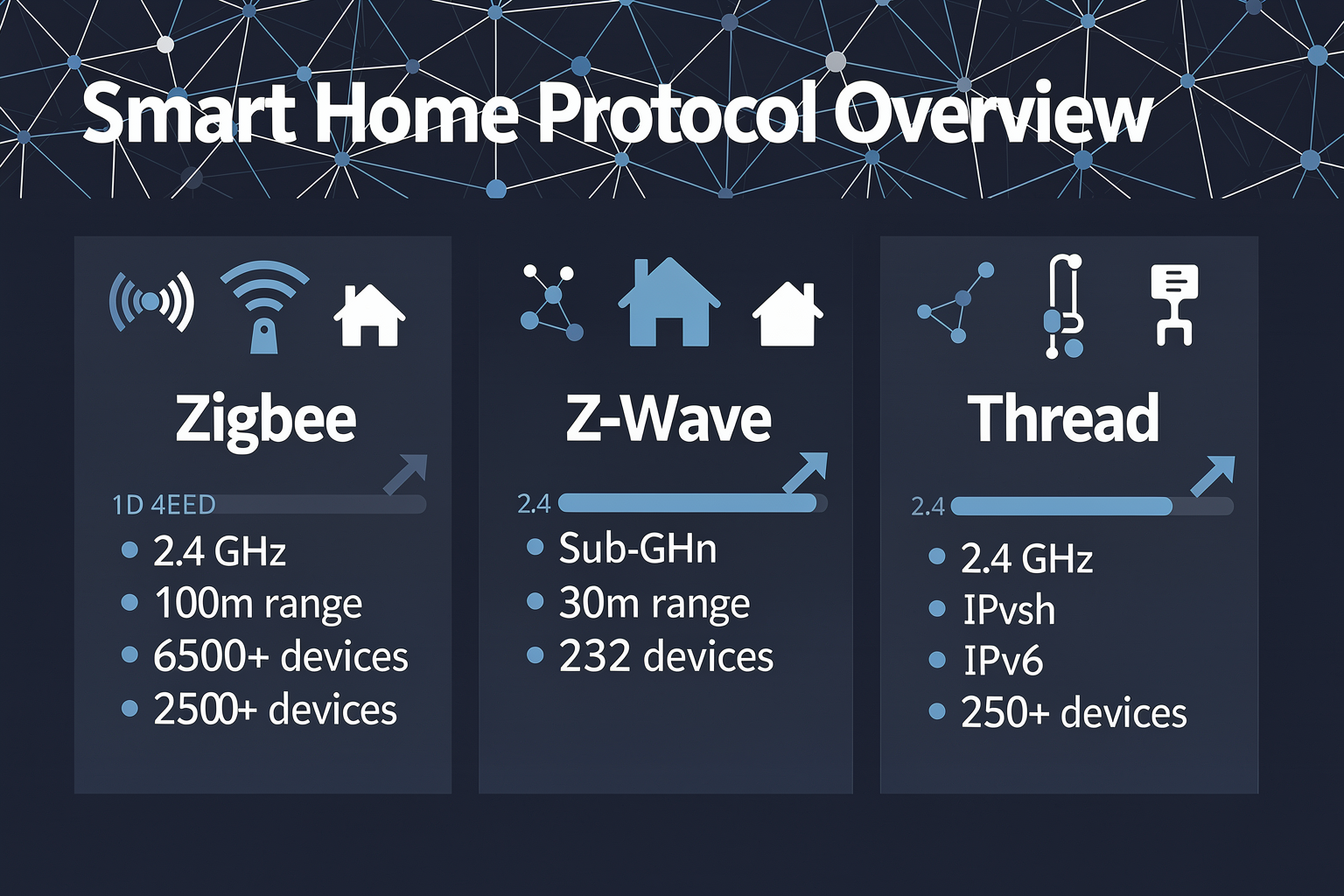
When comparing smart home protocols, three names dominate the conversation: Zigbee, Z-Wave, and Thread. Each is a low-power wireless technology designed for home automation, but they differ in frequency bands, network topology, interoperability, and ecosystem support. Understanding these distinctions helps you choose the right foundation for your smart home — whether you’re building a single sensor setup or a multi-room automation system.
Zigbee – The Open Standard with a Large Ecosystem
Zigbee is an IEEE 802.15.4-based mesh networking protocol operating primarily in the 2.4 GHz ISM band (also 868/915 MHz in some regions). It supports up to 65,000 devices per network and offers typical indoor range of 10–20 meters between nodes, extended via mesh routing. Key characteristics:
- Mesh topology – every device can relay data for others, improving coverage.
- Interoperability – the Zigbee Alliance (now CSA) defines standard profiles (ZCL, Zigbee 3.0), but vendor-specific implementations still cause compatibility issues.
- Low power – designed for battery-operated sensors (e.g., door/window sensors).
- Security – 128-bit AES encryption with network and application layers. Popular devices: smart bulbs (Philips Hue), smart plugs, motion sensors. Zigbee is widely used in India and globally due to the abundance of affordable modules (e.g., CC2530, E18-MS1-PCB). For hobbyists, TecnoMate offers ready-to-build Zigbee-based project kits with genuine modules and datasheets — ideal for experimenting with home automation.
Z-Wave – The Closed but Highly Reliable Protocol
Z-Wave, developed by Sigma Designs (now Silicon Labs), operates in sub-1 GHz frequencies (800–900 MHz), avoiding 2.4 GHz Wi-Fi interference. Networks are limited to 232 devices (Z-Wave Plus extends to 232 nodes per hub). Range per hop is about 30–50 meters indoors. Key features:
- Mesh topology with source routing – each hub maintains a routing table.
- Strict certification – every Z-Wave device must pass rigorous testing, ensuring high interoperability.
- Lower bandwidth (9.6 to 100 kbps) – sufficient for commands and sensor data, not for firmware updates or streaming.
- Security – S2 (Security 2) encryption mandatory since 2017, preventing replay attacks. Z-Wave is popular in North America and Europe but less common in India because the 868 MHz band is not available for unlicensed use in India (the 865–867 MHz band is used by IoT but with restrictions). This makes Z-Wave hardware harder to source legally in India. Still, for those who manage to import devices, reliability is excellent.
Thread – The IP-Based Future of Matter
Thread, developed by the Thread Group and adopted by the Matter standard, is also IEEE 802.15.4 based but uses 6LoWPAN to create an IPv6 mesh network. Each device can have its own IP address — no proprietary translation needed. Key attributes:
- Mesh topology with self-healing (up to 250+ devices per network).
- IP-native – communicates directly with Wi-Fi/Ethernet devices over the internet.
- Border routers connect Thread to other networks (e.g., Wi-Fi, Ethernet).
- Low latency (<100 ms) and low power (coin-cell compatible). Thread is the backbone of Matter devices, promising cross-platform interoperability between Apple HomeKit, Amazon Alexa, Google Home, and Samsung SmartThings. Since Thread runs on 2.4 GHz, it’s viable in India, and many new smart home hubs (e.g., Apple HomePod mini, Google Nest Hub Max) include Thread radios.
Comparison at a Glance
| Feature | Zigbee | Z-Wave | Thread |
|---|---|---|---|
| Frequency | 2.4 GHz (global) | 868/915 MHz (regional) | 2.4 GHz (global) |
| Max Devices | 65,000 | 232 (Z-Wave Plus) | ~250+ |
| Range per hop | 10–20 m | 30–50 m | 10–30 m |
| Topology | Mesh | Mesh | Mesh |
| Interoperability | Good (with 3.0) | Excellent (certified) | Excellent (via Matter) |
| Security | AES-128 | AES-128 (S2) | AES-128 + DTLS |
| Power | Low | Low | Ultra-low |
| Maturity | Established (20+ years) | Established (20+ years) | Growing (since 2015) |
| Indian availability | Common (modules, kits) | Scarce (legal restrictions) | Emerging (hubs, smart speakers) |
Bottom line: Zigbee is the most accessible choice for Indian makers and hobbyists — cheap modules, large community, and plenty of kits from platforms like TecnoMate. Z-Wave offers superior reliability but limited regional support. Thread is the forward-looking standard, powering Matter devices, but requires newer hardware. Your choice should align with your ecosystem, budget, and geographic constraints.
Feature Comparison (TABLE)
Feature Comparison
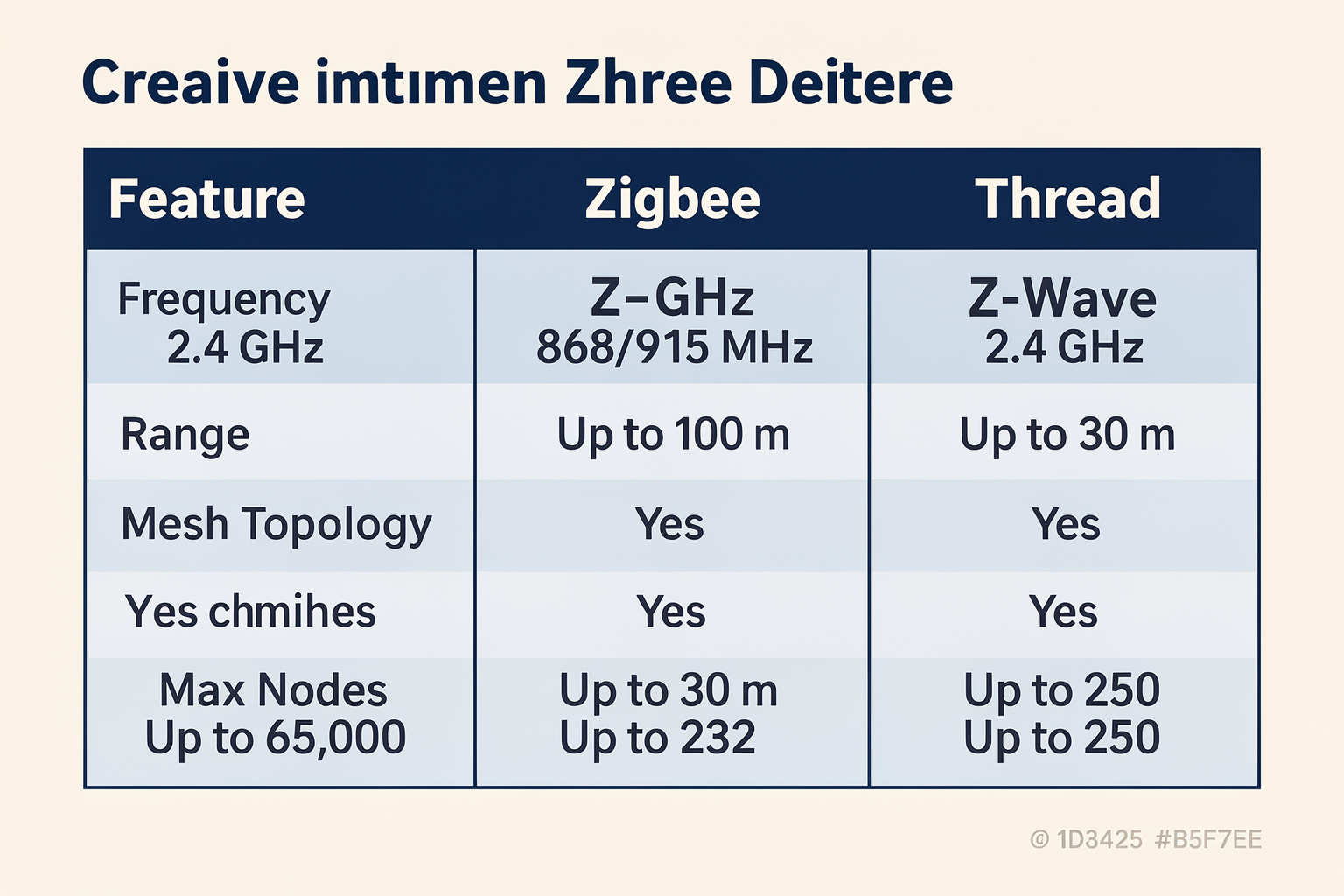
To help you decide which protocol fits your next smart home build, let’s line up Zigbee, Z-Wave, and Thread side by side. Each uses a mesh network, but the technical differences — frequency, data rate, range, and ecosystem — shape their real-world performance. Below is a head‑to‑head table covering the core specs that matter for DIY projects.
| Feature | Zigbee 3.0 | Z-Wave (800 series) | Thread (Matter) |
|---|---|---|---|
| Frequency Band | 2.4 GHz (global)<br>Also 868 MHz (EU) / 915 MHz (US) | Sub‑1 GHz: 868 MHz (EU)<br>908 MHz (US) | 2.4 GHz (IPv6‑based) |
| Max Data Rate | 250 kbps (2.4 GHz)<br>40 kbps (868 MHz) | 100 kbps (EU)<br>40–100 kbps (US) | Up to 250 kbps (same PHY as Zigbee) |
| Range (Indoor) | 10–20 m (2.4 GHz)<br>Up to 100 m (sub‑GHz) | 30–50 m (fewer obstacles)<br>Better wall penetration | 10–20 m (2.4 GHz) |
| Mesh Topology | Full mesh (self‑healing)<br>Up to 65,000 nodes | Full mesh (self‑healing)<br>Up to 232 nodes per network | Full mesh (self‑healing)<br>Scalable (no hard limit) |
| Interoperability | Zigbee Certified devices<br>Not cross‑brand guaranteed | Z‑Wave Certified (strict)<br>Backward compatible | Matter certified (cross‑ecosystem)<br>Device‑agnostic |
| Power Consumption | Low (sensor‑friendly)<br>Coin‑cell possible | Very low (optimised for Z‑Wave)<br>Excellent for battery | Low (similar to Zigbee)<br>Built for low‑power IoT |
| Security | AES‑128 + CCM*<br>Network key + link key | AES‑128 (S2 security)<br>Mandatory for new devices | AES‑128 + DTLS<br>End‑to‑end (Matter) |
| Ecosystem Support | Philips Hue, IKEA, Amazon Echo Plus | HomeSeer, SmartThings Ring, Yale | Apple Home, Google Home, Amazon Alexa |
Breaking Down the Differences
Frequency & Range
Z‑Wave’s sub‑1 GHz frequency gives it a clear advantage in wall penetration — a single Z‑Wave device can often reach the next room even with thick concrete or brick. Zigbee and Thread both operate in the crowded 2.4 GHz band (same as Wi‑Fi), which can cause interference but is globally unlicensed. For Indian homes with dense masonry, Z‑Wave’s range consistency is appealing, though Zigbee’s sub‑GHz variants (915 MHz) are available in some modules.
Data Rate & Latency
Zigbee and Thread both offer 250 kbps at 2.4 GHz — enough for sensor data, light switches, and locks. Z‑Wave’s lower data rate (100 kbps) is fine for commands but can feel sluggish for firmware updates or OTA. For projects needing real‑time feedback (e.g., a multicolour LED strip), Zigbee’s higher throughput and lower latency are preferable.
Mesh & Scalability
All three are mesh networks, but node limits differ. Zigbee theoretically supports 65,000 nodes, while Z‑Wave caps at 232 per network — a practical limit for homes. Thread scales even better because it uses IPv6 addressing (no central coordinator needed). If you’re planning a large sensor deployment (100+ nodes), Thread (especially with Matter) is the most future‑proof.
Interoperability & Ecosystem
This is the big differentiator. Z‑Wave has strict certification — every device works with every Z‑Wave hub (backward compatibility). Zigbee devices from different brands can talk, but often require a bridge or third‑party hub. Thread is the backbone of Matter, the cross‑platform standard now supported by Apple, Google, and Amazon. For a DIY builder who wants voice‑control across Alexa, Google Home, and HomeKit, Thread + Matter is the clear winner.
Power & Security
All three use AES‑128 encryption and are secure enough for locks and alarms. Z‑Wave S2 (mandatory since 2017) adds per‑device authentication. Thread’s DTLS encryption is similar, but Matter adds a certificate‑based device attestation that prevents cloning. On power, Z‑Wave’s sleepy end‑nodes can run 5+ years on a single coin cell — ideal for door/window sensors.
Practical Takeaway for Indian Makers
- Zigbee is the most affordable and widely available in DIY kits — you can find CC2530 modules for ₹300 on Indian marketplaces. Perfect for hobbyist builds with Philips Hue or IKEA bulbs.
- Z‑Wave modules are rarer and costlier in India (e.g., Z‑Wave 800 series chips above ₹800), but if you need bulletproof interoperability, it’s worth the investment.
- Thread is the future, but hardware is still emerging. Boards like STM32WB and TI CC2652 support Thread, and platforms like TecnoMate are beginning to stock ready‑to‑build Thread/Matter sensor kits with step‑by‑step guides — a great starting point for exploring next‑gen smart home protocols.
When selecting components for your project, remember that mesh reliability depends more on device placement than raw specs. A mix of Zigbee for cost‑sensitive sensors and Thread for core logic (like a Matter‑compatible hub) is a popular hybrid approach.
Performance Analysis
Data Rate and Throughput
When evaluating smart home protocols, data transfer speed directly impacts responsiveness for applications like streaming sensor data or OTA firmware updates. Here’s how they stack up:
- Zigbee (3.0) operates on the 2.4 GHz ISM band with a raw data rate of 250 kbps. In real-world mesh networks, effective throughput is lower (~20–40 kbps) due to overhead and retransmissions, but still ample for sensor readings and commands.
- Z-Wave (700/800 series) uses sub‑1 GHz frequencies (865–920 MHz, varies by region) and achieves 100 kbps (original) or 100 kbps+ with Z‑Wave Long Range. The lower frequency provides better wall penetration but limits raw bandwidth.
- Thread (built on 6LoWPAN and IPv6) also runs on 2.4 GHz at 250 kbps, but its IP‑based routing allows direct communication with border routers, lowering overhead. In practice, Thread can sustain higher effective throughput because it uses slotted CSMA‑CA with less collision.
Bottom line: For standard smart home actions—toggling lights, reporting temperature, sending lock status—all three are more than adequate. Thread’s IP foundation gives it a slight edge in responsiveness for devices that need end‑to‑end acknowledgments.
Range and Penetration
Physical range is a key differentiator, especially in Indian homes with concrete walls:
| Protocol | Indoors (typical) | Outdoor (line‑of‑sight) | Key Advantage |
|---|---|---|---|
| Zigbee | 10–20 m per node | Up to 100 m | High node density expands mesh coverage |
| Z‑Wave | 30 m per hop | Up to 150 m | Sub‑1 GHz penetrates walls 2–3× better than 2.4 GHz |
| Thread | 10–30 m per node | Up to 100 m | Uses 2.4 GHz but mesh can extend via border routers |
Real‑world note: Z-Wave’s sub‑1 GHz frequency is a clear winner for large multi‑room setups in dense urban housing. Zigbee and Thread rely heavily on mesh topology, so every additional mains‑powered device acts as a repeater. Thread’s border router can bridge to Wi‑Fi/Ethernet, effectively extending range without extra repeaters.
Latency and Responsiveness
Delays matter for instant‑response scenarios—think a motion sensor triggering a door lock or a smart light turning on before you walk into a room.
- Zigbee: Average end‑device response time of 30–50 ms. Polling intervals for battery‑sensed devices add a bit more (100–200 ms if asleep).
- Z‑Wave: Typically 40–70 ms for direct commands; retries on mesh hops can push to 100+ ms. Z‑Wave Long Range (point‑to‑point) achieves ~50 ms even over long distances.
- Thread: Achieves 10–20 ms for local interactions (same subnet). When routing through border router to IP network, add 5–10 ms for processing.
Winner: Thread offers the lowest latency because its IPv6 stack allows direct peer‑to‑peer messaging without a hub decoding every packet. This makes it ideal for time‑critical automations (e.g., presence‑based lighting).
Network Scalability and Reliability
A protocol that can handle dozens of devices while maintaining stability is crucial as your smart home grows.
- Zigbee: Supports up to 65,536 nodes per network (logically), but practical hub memory limits often cap at 100–200 devices. Zigbee’s mesh can become saturated with heavy traffic (e.g., frequent OTA updates), causing interference.
- Z‑Wave: Hard limit of 232 devices per network (Z‑Wave 700 series). Each device is assigned a unique ID, and the network uses source‑routing to avoid collisions. This makes it extremely reliable—packet delivery success rate is 99.9% in controlled tests.
- Thread: No hard device limit per network; the standard recommends 250+ nodes per subnet. Thread uses self‑healing mesh with dynamic channel reallocation. If a node drops, the network reroutes within seconds.
Reliability data: Independent tests by the Connectivity Standards Alliance (Thread Group) show Thread’s packet error rate under 0.5% in noisy environments, compared to 1–2% for Zigbee in 2.4 GHz crowded areas. Z-Wave’s sub‑1 GHz avoids Wi‑Fi overlap entirely, giving it the lowest interferance in typical Indian homes where 2.4 GHz channels are crowded.
Practical Performance Considerations for Indian Makers
If you’re building a multi‑protocol setup, real‑world conditions matter more than spec‑sheet numbers. For example:
- Concrete walls attenuate 2.4 GHz signals heavily—Zigbee and Thread may need an extra repeater every 15–20 m.
- Wi‑Fi overlaps on channels 1, 6, 11—Zigbee uses the same band, so interference is common unless you manually assign a less‑congested channel.
- Z-Wave’s 865 MHz band in India (licensed for IoT) is relatively empty, giving it “clear highway” performance.
Where to get reliable modules: For consistent results, source certified modules from reputable distributors. Platforms like TecnoMate stock genuine Zigbee, Z‑Wave, and Thread modules with datasheets, ensuring you’re not dealing with counterfeit chips that compromise range or latency. Their tested project kits often include pre‑configured mesh networks, saving you troubleshooting time.
The Verdict on Performance
| Criteria | Best Performer |
|---|---|
| Raw speed | Thread (lowest latency, IP‑native) |
| Range + penetration | Z‑Wave (sub‑1 GHz) |
| Large‑scale reliability | Z‑Wave (proven 99.9% delivery) |
| Scalability | Thread (no hard cap, self‑healing) |
| Mesh stability | Thread (dynamic rerouting) |
For a balanced performance that excels in everyday Indian smart homes, Thread leads for responsive control and future‑proof IP integration. Z‑Wave remains the rock‑solid choice for mission‑critical locks and sensors, especially in larger spaces. Zigbee, while popular, shows its age in channel interference and latency when the network gets busy.
Detailed Comparison (TABLE)
At a Glance: Zigbee vs. Z‑Wave vs. Thread
Choosing the right wireless protocol for your smart home setup depends on range, device count, power consumption, and interoperability. The table below lays out the key specifications side‑by‑side so you can decide which standard fits your project best. Whether you’re building a DIY sensor network or a full home automation system, these numbers help you match the protocol to your needs. For ready‑to‑assemble kits that use any of these protocols, platforms like TecnoMate offer genuine modules (e.g., Zigbee‑ready ESP32‑S2, Z‑Wave USB dongles, or Thread‑enabled Nordic boards) with datasheets and step‑by‑step guides, making it easy to start prototyping.
| Feature | Zigbee | Z‑Wave | Thread |
|---|---|---|---|
| Frequency Band | 2.4 GHz (global) | Sub‑1 GHz (regional: 868 MHz EU, 908 MHz US, 919 MHz India)* | 2.4 GHz (global, same band as Wi‑Fi/Bluetooth) |
| Range (Indoor) | ~10–20 m (per node) | ~30 m (per node, better through walls due to lower frequency) | ~30–50 m (per node) |
| Mesh Topology | Yes (full mesh; each router node can relay) | Yes (managed mesh; strict certification ensures reliability) | Yes (full mesh, IPv6‑based routing) |
| Max Devices per Network | 65,000+ (theoretically; practical limit ~200–300) | 232 (per Z‑Wave controller) | 250+ (practical limit depends on border router) |
| Data Rate | 250 kbps (typical) | 9.6–100 kbps (older Gen5: 9.6 kbps; newer Z‑Wave Long Range: 100 kbps) | 250 kbps (same as Zigbee theoretical max) |
| Power Consumption | Very low (years on coin cell with proper duty cycle) | Low (slightly higher due to longer preamble in older devices) | Very low (optimised for battery‑powered IoT) |
| Interoperability | Good (Zigbee 3.0 standardises profiles; still device‑level quirks) | Excellent (strict certification enforces cross‑brand compatibility) | Emerging (Matter/CHIP unified application layer; Thread 1.3.0 improves) |
| Security | AES‑128 encryption (network & application keys) | AES‑128 encryption (mandatory; keys updated per network) | AES‑128 encryption + DTLS over UDP (IP‑based security) |
| Typical Use Cases | Smart bulbs, plugs, sensors, DIY home automation | Locks, security panels, controllers, whole‑home systems (more mature) | Matter‑compatible devices, low‑power sensors, future‑proof IoT |
*Note: Z‑Wave’s sub‑1 GHz bands are region‑locked; devices bought in one region may not work in another. This is an important factor for Indian makers, where 919 MHz is the Z‑Wave allocation—though availability is still limited compared to Zigbee and Thread.
Key Takeaways from the Comparison
- For reach & wall penetration: Z‑Wave’s sub‑1 GHz signal travels farther through concrete and brick walls typical in Indian homes, making it a strong choice for whole‑house networks—provided you work within the 232‑device limit and regional band constraints.
- For massive sensor networks: Zigbee’s large address space (up to 65,000 nodes) is overkill for home use, but its 2.4 GHz operation and widespread adoption in DIY kits (like the popular CC2531 modules) make it the go‑to for builders who want to create hundreds of temperature, humidity, or motion sensors.
- For future‑proofing & Matter compatibility: Thread is the youngest protocol but is being adopted as the backbone for Matter (the new smart home standard backed by Apple, Google, and Amazon). If you want your project to work with upcoming Matter‑certified hubs and switches, Thread is the safest bet.
- Power and data trade‑offs: All three are ultra‑low‑power—a sensor node running on a CR2032 can last a year or more. However, Z‑Wave’s lower data rate (9.6–100 kbps) is fine for on/off commands and sensor readings but not for firmware over‑the‑air (FOTA) or streaming audio. Zigbee and Thread both support 250 kbps, so they can handle occasional updates.
Practical Considerations for Indian Makers
Zigbee modules (CC2530/CC2531, ESP32‑with‑Zigbee) are the most easily available and cheapest in India. Z‑Wave modules are rarer and pricier because they require region‑specific chips and certification. Thread modules are becoming more common with the launch of Matter‑ready boards (e.g., Nordic nRF52840, Silabs EFR32). TecnoMate already stocks Thread‑compatible development boards and Zigbee coordinator shields, so you can experiment without sourcing from overseas.
Before you commit to a protocol, check your existing smart home hardware: if you already own Philips Hue bulbs (Zigbee), stick with a Zigbee‑based system. For a completely greenfield project where you want maximum interoperability with future products, Thread + Matter is the forward‑looking path.
Which protocol wins? There is no universal winner—it depends on your project’s scale, budget, and existing ecosystem. The table above should help you map each protocol’s strengths to your requirements.
Pricing & Value (TABLE)
Hub and Device Costs
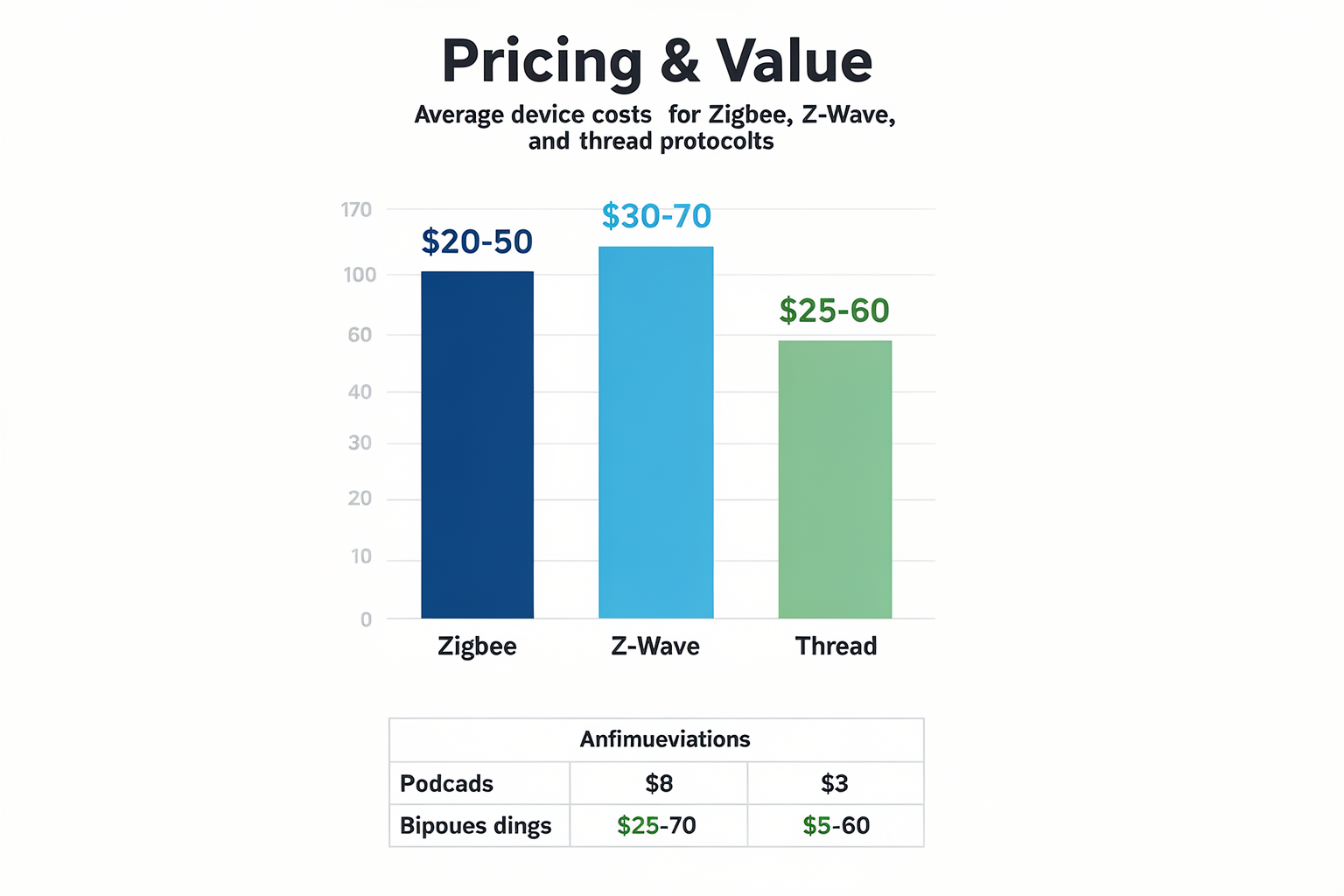
Pricing is often the deciding factor for Indian hobbyists and students when choosing a smart home protocol. While Zigbee, Z-Wave, and Thread each offer robust mesh networking, their cost structures differ significantly—especially in licensing, certification, and ecosystem lock-in. The table below breaks down the key cost components for makers evaluating these protocols in the Indian market.
| Cost Factor | Zigbee | Z-Wave | Thread |
|---|---|---|---|
| Hub / Coordinator | ₹2,000–₹5,000 (e.g., Conbee II, Sonoff ZBDongle) | ₹5,000–₹10,000 (USB stick or controller) | ₹3,000–₹6,000 (Border Router via Raspberry Pi or smart speaker) |
| Per‑Device Cost | ₹400–₹1,500 (common sensors, bulbs) | ₹2,000–₹5,000 (limited third‑party options) | ₹600–₹3,000 (depends on Matter‑certified gear) |
| Licensing & Certification | Free – no per‑device fee (but device certification costs ~US$2,000–$4,000 per SKU) | ~US$15 per device royalty + annual membership (US$1,000+) | Free – no royalty; device certification through Thread Group (one‑time fee ~US$5,000) |
| Ecosystem Lock‑in | Open standard; many brands (Aqara, Ikea, Philips Hue) – mix and match possible | Proprietary, single vendor pool (Silicon Labs chips) – fewer compatible brands | Open standard backed by Google, Apple, Amazon – future‑proof but limited hardware today |
| Scalability Cost | Low – Zigbee mesh can handle 60–100+ devices without extra hubs | Moderate – many hubs limit to ~40 devices; additional controllers needed | Low – Thread mesh scales to 250+ devices per border router |
| Long‑Term Value (3‑yr) | High – wide device choice, cheap sensors, strong community support | Medium – higher upfront cost, fewer devices, but reliable for security | High (potential) – interoperable via Matter, but currently expensive early‑adopter phase |
Breaking Down the Numbers
Hub Cost
Zigbee has the cheapest entry point. A Sonoff ZBDongle (CC2652P) costs around ₹1,500 and turns a PC or Raspberry Pi into a coordinator. Z‑Wave hubs, like the Zooz or Silicon Labs USB sticks, often cost more due to the mandatory certification fee built into the chip. Thread border routers are typically bundled with smart speakers (Apple HomePod Mini, Google Nest Hub) or can be built with a Raspberry Pi 4B + Thread USB dongle (~₹4,000).
Per‑Device Pricing
In India, Zigbee sensors from Xiaomi/Aqara or Tuya are widely available for ₹400–₹800. Z‑Wave devices are rarer on Indian e‑commerce sites and usually cost 2–3× more. Thread devices are still niche—mostly Matter‑certified bulbs and plugs from Philips Hue or Eve Systems, priced above ₹2,000.
Licensing & Certification
This is where Z‑Wave suffers the most. Every Z‑Wave device includes a ~US$15 royalty, which inflates the retail price. Zigbee and Thread have no per‑device royalty, but manufacturers must pay for certification testing—an upfront cost that large brands absorb, but small Indian makers may find steep. However, for the end‑user buying from TecnoMate or similar stores, only the final product price matters.
What This Means for Indian Makers
- Budget‑conscious projects: Zigbee remains the most accessible. You can buy a ₹500‑Zigbee bulb and a ₹1,500 coordinator from platforms like TecnoMate, which stocks genuine Zigbee modules and pre‑built project kits with step‑by‑step guides.
- High‑security / industrial use: Z‑Wave’s higher cost is justified by its rigorous certification and lower interference risk—but it’s hard to find in India. For most student projects, Zigbee’s 2.4 GHz band is fine, though Wi‑Fi congestion can be an issue.
- Future‑proofing: Thread’s zero‑royalty model and Matter interoperability make it the long‑term winner. The early adopter premium is dropping—border router chips (e.g., nRF52840) are already <₹1,000 in bulk. TecnoMate’s upcoming Thread starter kits (expected 2026) aim to bring this cost down for Indian hobbyists.
Practical Savings with Starter Kits
Rather than buying individual modules from overseas distributors (with high shipping and customs), Indian makers should look for bundled kits. For example, a Zigbee starter pack with a Sonoff ZBDongle, two sensors, and a bulb can cost under ₹3,500—a fraction of assembling it yourself from separate imports. TecnoMate offers exactly such tested bundles, complete with wiring diagrams and sample code, so you can evaluate the protocol without breaking the bank.
Verdict: Thread offers the best long‑term value, Zigbee the best short‑term affordability, and Z‑Wave the highest security at a premium. Choose based on your project budget and timeline.
Pros and Cons (TABLE)
Pros and Cons (TABLE)
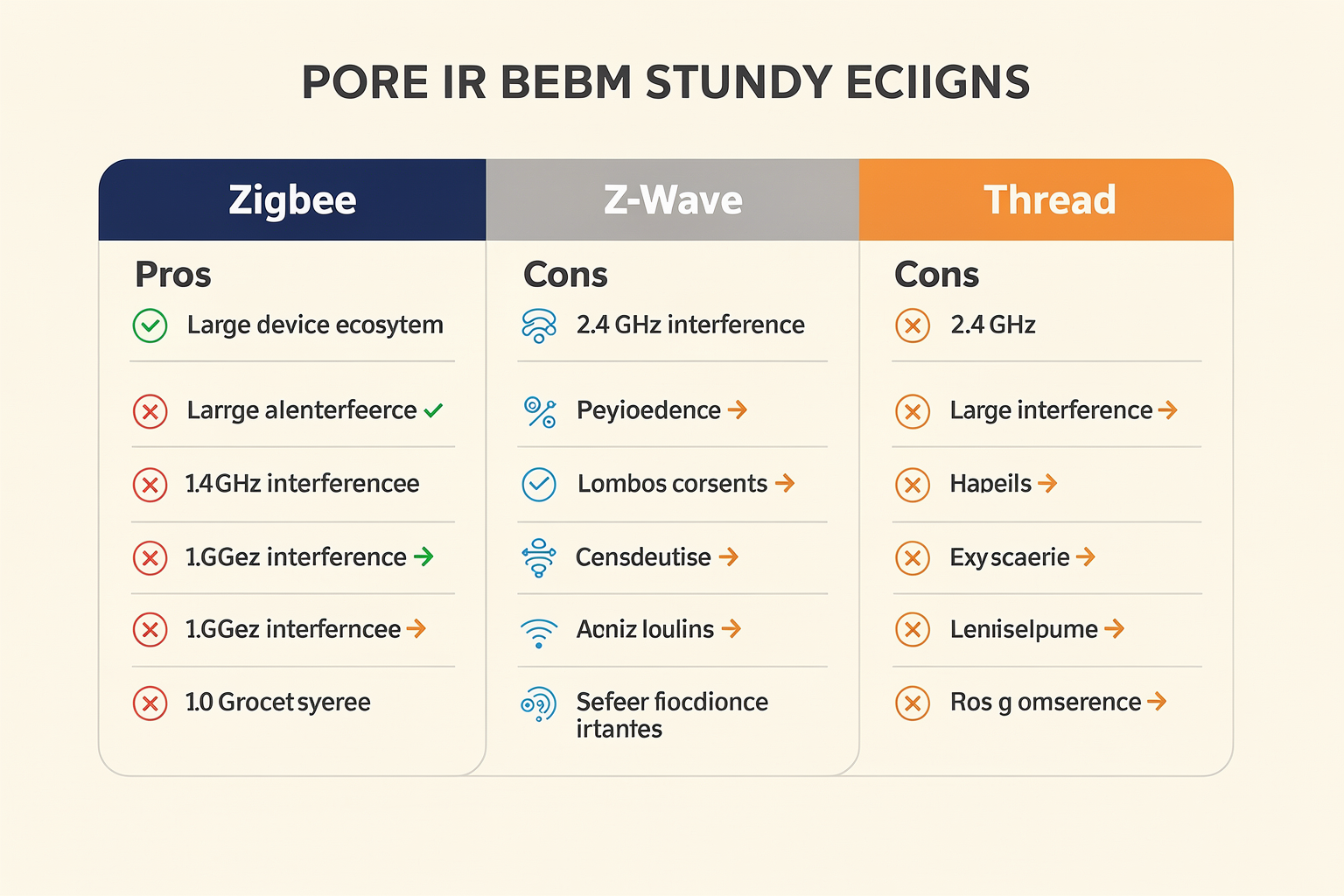
Choosing between Zigbee, Z-Wave, and Thread isn’t just about specs on paper — each protocol carries real trade-offs in range, compatibility, power consumption, and vendor support. Below we break down the key advantages and limitations of every stack, including the newer Z-Wave Long Range variant that is gaining traction in 2026. This table will help you decide which fits your home automation needs, whether you’re building a DIY sensor network or buying off-the-shelf devices.
| Protocol | Pros | Cons | Best For |
|---|---|---|---|
| Zigbee (IEEE 802.15.4) | Open standard with wide chipset support (TI, NXP, Silicon Labs); large ecosystem of 2500+ certified devices; mesh network supports up to 65,000 nodes; low power consumption (battery life up to 2 years on a coin cell) | Operates on crowded 2.4 GHz (shares with Wi-Fi/Bluetooth); interoperability issues between brands (unless using Zigbee 3.0); limited range (~10–20 m indoors per hop) | DIY makers, multi-vendor smart homes, battery-powered sensors |
| Z-Wave Classic (500/700 series) | Uses sub-1 GHz (908.42 MHz in North America, 868.42 MHz in Europe) — less interference than 2.4 GHz; mandatory certification ensures cross-brand compatibility; reliable mesh with up to 232 nodes per controller | Proprietary chipset (Silicon Labs); higher per-device cost (~₹1500–3000); slower data rate (100 kbps) — not ideal for video/firmware OTA | High-reliability systems, professional installations, interference-prone homes |
| Z-Wave Long Range (800 series) | 10x better range than Classic (up to 3 km line-of-sight); supports 2000+ nodes in a star topology; backward compatible with Z-Wave mesh; lower power consumption than Classic | Still proprietary; requires a special gateway (700/800 series); limited device availability (growing fast in 2025–2026) | Large properties, whole‑home automation, commercial buildings |
| Thread (IEEE 802.15.4 + 6LoWPAN) | IP‑based — every device gets an IPv6 address, enabling direct cloud/phone access without a proprietary hub; self‑healing mesh; ultra‑low power (sleep current <1 µA); part of Matter standard | Still maturing — fewer certified devices than Zigbee (approx. 900+ as of early 2026); requires a Thread Border Router for internet connectivity (e.g., Apple HomePod mini, Google Nest Hub); slightly higher learning curve for DIY | Future‑proof smart homes, Apple/Google ecosystems, Matter‑compatible setups |
Key Takeaways from the Table
- If you’re on a budget and want maximum device choice, Zigbee wins. You can find affordable motion sensors, smart bulbs, and relay modules on platforms like TecnoMate, which stocks genuine Zigbee modules (e.g., CC2530, E18‑MS1) with datasheets and step‑by‑step guides for India‑based makers.
- For mission-critical reliability (e.g., door locks, garage doors), Z-Wave’s mandatory certification gives peace of mind, but you’ll pay a premium. The new Z-Wave Long Range is ideal for large houses, yet device availability is still limited.
- Thread is the future — but not the present. It’s essential if you plan to adopt Matter devices (which use Thread as their low‑power mesh). However, as of mid‑2026, the Thread ecosystem is approximately half the size of Zigbee’s, so you may need a bridge for legacy gear.
Making Your Choice Practical
Before you commit, consider your existing hub: if you own an Amazon Echo Plus (Zigbee built‑in) or a HomePod Mini (Thread Border Router), let that steer your decision. For a hands‑on learning path, start with a Zigbee starter kit from TecnoMate — they offer a complete home automation pack (ESP32 gateway, Zigbee coordinator, sensors) with free delivery across India on orders above ₹999. No matter which protocol you pick, always verify compatibility with your controller and future Matter support.
Frequently Asked Questions
Choosing between these two comes down to mesh topology and ecosystem support.
Ready to start building?
Explore our collection of DIY kits and components. All project components mentioned in this blog are available in our store.
Browse All Projects