Arduino Boards & Compatibles
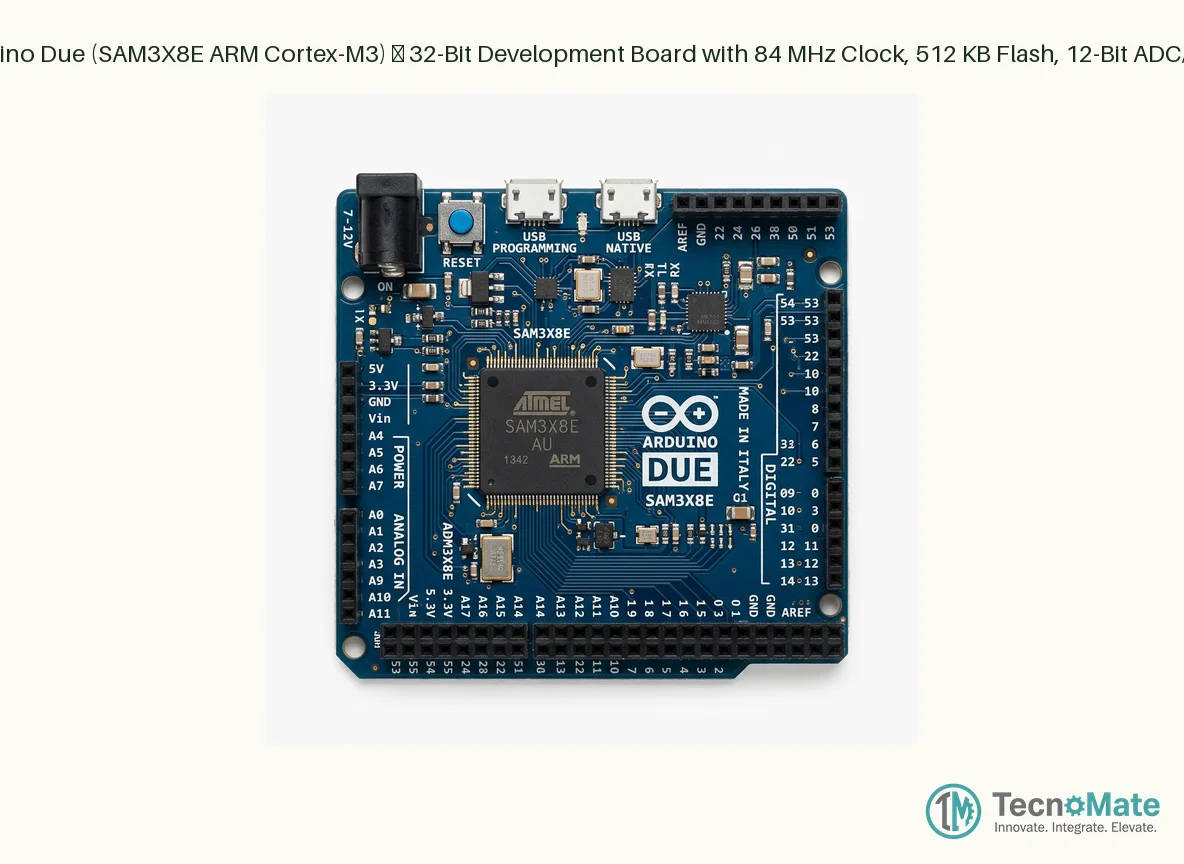
Arduino Due (SAM3X8E ARM Cortex-M3) – 32-Bit Development Board with 84 MHz Clock, 512 KB Flash, 12-Bit ADC/DAC
The Arduino Due is a landmark development board — the very first Arduino built around a 32-bit ARM core. At its heart beats the Atmel SAM3X8E ARM Cortex-M3 processor, clocked at a blistering 84 MHz, delivering processing power that leaves 8-bit AVR boards far behind. This is the board you reach for when your project demands real computational muscle: digital signal processing, real-time control loops, audio synthesis, or high-speed data acquisition.
With 54 digital I/O pins (12 of which support PWM), 12 analog inputs featuring 12-bit ADC resolution, and — uniquely among classic Arduino boards — 2 true analog outputs via 12-bit DACs, the Due opens doors to applications that are simply impractical on an Uno or Mega. The 512 KB of onboard Flash memory gives you room for large, complex sketches, while 96 KB of SRAM handles hefty runtime data. Four hardware UARTs, two I2C (TWI) buses, a dedicated SPI header, and a CAN bus controller make interfacing with sensors, actuators, and industrial equipment straightforward.
⚠️ Important: The Due operates entirely at 3.3V logic. Its I/O pins are NOT 5V tolerant — connecting 5V signals directly will permanently damage the board. Level shifters are essential when interfacing with 5V sensors or modules. The board can be powered via USB or the barrel jack (7-12V recommended), includes both a programming USB port and a native USB OTG port for hosting USB devices, and even breaks out a JTAG header for advanced debugging.
Whether you're an engineering student building a capstone project, a hobbyist pushing beyond the limits of 8-bit microcontrollers, or a professional prototyping an ARM-based embedded system, the Arduino Due delivers genuine 32-bit capability with the approachable Arduino ecosystem you already know. This is the Arduino Due A000062 — the official board manufactured by Arduino with gold-plated pads, reliable voltage regulation, and full compatibility with the Arduino IDE and library ecosystem.
Specifications
SPI: 1 (dedicated header)
USB: 1 Programming Port (ATMEGA16U2) + 1 Native USB OTG
JTAG: Yes (10-pin header)
SRAM: 96 KB (64 KB + 32 KB)
UARTs: 4 (including 1 with RTS/CTS)
Weight: ~36 g
CAN Bus: 2 controllers (CAN0, CAN1)
I2C (TWI): 2
Clock Speed: 84 MHz
Architecture: 32-bit ARM Cortex-M3
Flash Memory: 512 KB
PCB Dimensions: 101.52 x 53.3 mm
Microcontroller: AT91SAM3X8E (Atmel SAM3X8E)
Digital I/O Pins: 54 (12 PWM-capable)
Analog Input Pins: 12 (12-bit ADC, 4096 steps)
Operating Voltage: 3.3V (I/O)
Analog Output Pins: 2 (12-bit DAC)
DC Current per I/O Pin: 3 mA (source) / 6 mA (sink)
Input Voltage (Limits): 6-16V DC
DC Current for 3.3V Pin: 800 mA
Input Voltage (Recommended): 7-12V DC
Total DC Current on all I/O Lines: 130 mA
Details
The Arduino Due represents a paradigm shift in the Arduino lineup. While the Uno and Mega are beloved workhorses, their 8-bit ATmega cores struggle with computationally intensive tasks. The Due's 32-bit ARM Cortex-M3 changes everything. Let's dive deep into what makes this board special and why it might be the perfect brain for your next project.
## Why 32-Bit Matters
An 8-bit microcontroller like the ATmega328P (Arduino Uno) processes data in 8-bit chunks at 16 MHz. The SAM3X8E on the Due processes 32 bits at a time at 84 MHz. In practical terms, the Due can perform complex mathematical operations — multiply, divide, floating-point — in a fraction of the cycles an 8-bit AVR needs. For projects involving FFT analysis, real-time sensor fusion, PID control loops at high frequency, or audio processing, the Due is not just faster; it's in a different league entirely.
## True Analog Output (DAC)
Most Arduino boards can only approximate analog output via PWM. The Due includes two genuine 12-bit digital-to-analog converters (DAC0 and DAC1), capable of producing smooth, continuous voltage waveforms. This is transformative for audio projects, function generation, programmable power supplies, and precision analog control. The 12-bit resolution gives you 4096 discrete voltage levels between 0V and 3.3V.
## 12-Bit ADC Precision
The Due's 12 analog inputs use a 12-bit analog-to-digital converter, offering 4096 steps of resolution compared to the Uno's 10-bit (1024 steps) ADC. This 4× improvement in precision matters when you're reading sensitive sensors — thermocouples, strain gauges, precision current sensors — where every millivolt counts.
## CAN Bus — Industrial Ready
The SAM3X8E includes two CAN bus controllers. CAN (Controller Area Network) is the backbone of automotive and industrial communication. With the Due and a CAN transceiver, you can interface with vehicle OBD-II systems, industrial PLCs, and multi-node sensor networks — capabilities usually found only on expensive dedicated CAN hardware.
## Native USB OTG
The Due's native USB port supports USB On-The-Go, meaning the board can act as a USB host for keyboards, mice, game controllers, or USB Flash drives — or as a USB device (HID, MIDI, mass storage). This is a huge advantage for projects that need to talk directly to USB peripherals without a PC in between.
## Who Is This Board For?
Engineering students working on final-year projects involving DSP, control systems, or automation will find the Due's power liberating. Experienced hobbyists who've outgrown the Uno and Mega will appreciate the headroom. IoT developers needing an edge-computing node with CAN bus and multiple UARTs will find the Due perfectly suited. If you're building a 3D printer or CNC controller, the Due's speed and memory support complex motion planning (it is, in fact, the brain behind many 32-bit controller boards like the RAMPS-FD and RADDS).
## A Word of Caution: 3.3V Logic
This cannot be overstated: the Arduino Due is NOT 5V tolerant. Every I/O pin operates at 3.3V maximum. Connecting 5V directly to any I/O pin will likely destroy that pin or the entire board. Always use logic-level converters or voltage dividers when interfacing with 5V sensors, displays, or modules. This is the single most common reason for Due failures, especially among users transitioning from 5V Arduino boards.
## Arduino IDE Compatibility
The Due is fully supported in the Arduino IDE. In the Boards Manager, install "Arduino SAM Boards (32-bits ARM Cortex-M3)" and select "Arduino Due (Programming Port)" or "Arduino Due (Native USB Port)." Most standard Arduino libraries work out of the box, and the ARM GCC toolchain provides excellent code optimization for the Cortex-M3 core.
## Original Arduino Quality
This is the Arduino Due (A000062), the official board designed and manufactured by Arduino. It features gold-plated I/O pads for corrosion resistance, a high-quality 4-layer PCB, robust voltage regulators, polyfuse overcurrent protection on USB, and thoroughly tested bootloader firmware. When sourcing this board, always purchase through authorized distributors to ensure you receive a genuine product with the reliability and full ecosystem compatibility that the Arduino name guarantees.