Arduino Boards & Compatibles
Arduino Due R3 CH340 Clone – AT91SAM3X8E ARM Cortex-M3 Development Board
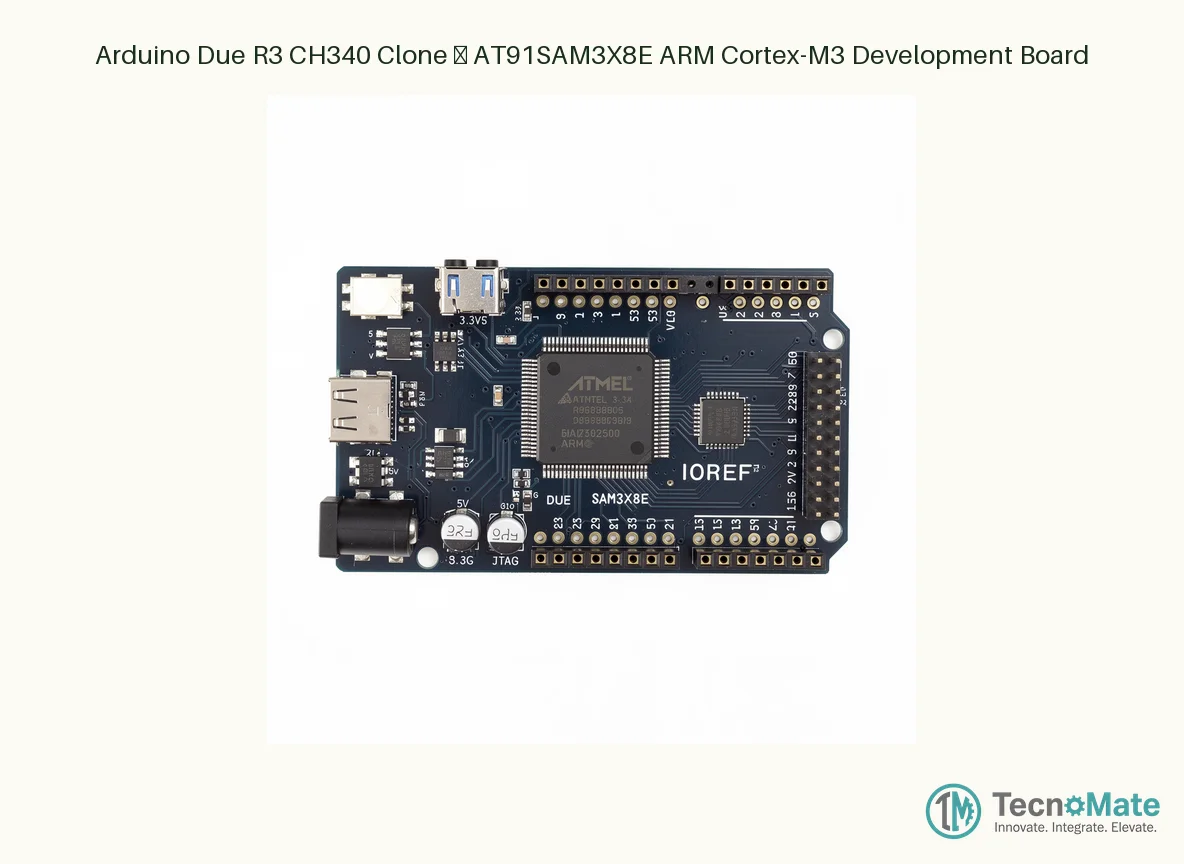
The Arduino Due R3 CH340 Clone is a high-performance 32-bit ARM-powered development board built around the Atmel AT91SAM3X8E microcontroller — the same powerful chip that drives the original Arduino Due. This clone variant swaps the ATmega16U2 USB-to-Serial bridge for the widely adopted CH340G chip, delivering near-identical functionality at a significantly lower price point. Running at 84 MHz with 512 KB of flash memory and 96 KB of SRAM, this board is purpose-built for projects that demand serious computational horsepower: real-time DSP, motor control, 3D printer controllers, CNC machines, IoT gateways, and advanced robotics.
With 54 digital I/O pins (12 of which support hardware PWM), 12 analog inputs, 4 independent hardware UARTs, two 12-bit DAC outputs, a Micro-USB port for programming via the CH340G, and a separate Native USB OTG port, the board offers connectivity and control versatility far beyond 8-bit Arduino platforms. The board operates at 3.3V logic levels — a critical consideration when interfacing with sensors and peripherals — and accepts 7–12V DC input via the barrel jack or VIN pin. The CH340G USB-to-Serial bridge handles programming and serial communication over the Micro-USB port; installing the CH340 driver is a one-time setup that works reliably on Windows (10/11), macOS, and modern Linux distributions.
This clone board is fully compatible with the Arduino IDE and the broader Arduino ecosystem. You get the full 32-bit ARM experience — more memory, richer libraries, and the ability to run FreeRTOS or bare-metal ARM code — at a fraction of the cost of the original. Whether you are an engineering student building a final-year capstone project, a hobbyist exploring high-speed data acquisition, or a professional prototyping an embedded product, this board delivers outstanding performance per rupee.
Specifications
SRAM: 96 KB (64 KB + 32 KB in two banks)
Weight: ~36 g
Clock Speed: 84 MHz
Architecture: 32-bit ARM
Flash Memory: 512 KB
Hardware UARTs: 4
PCB Dimensions: ~101.5 × 53.3 mm
USB Interfaces: 1 × Micro-USB (Programming via CH340G) + 1 × Native USB OTG
Microcontroller: AT91SAM3X8E (Atmel ARM Cortex-M3)
SPI / I2C / CAN: 1 × SPI, 2 × I2C (TWI), 2 × CAN
Digital I/O Pins: 54 (of which 12 support hardware PWM)
Analog Input Pins: 12 (12-bit ADC resolution)
Operating Voltage: 3.3V (I/O logic level)
USB-to-Serial Chip: CH340G
JTAG / Debug Header: Yes (10-pin)
Analog Outputs (DAC): 2 channels (12-bit resolution)
DC Current per I/O Pin: 3–15 mA (recommended max 9 mA)
Input Voltage (Limits): 6–20V DC
DC Current for 3.3V Pin: 800 mA
Input Voltage (Recommended): 7–12V DC
Details
The Arduino Due R3 CH340 Clone is the smart choice for Indian makers who need 32-bit ARM Cortex-M3 power without the premium price tag. Let's walk through exactly what makes this board special and why it's become a favourite in labs, workshops, and engineering colleges across India.
At the heart of the board sits the Atmel SAM3X8E — a 32-bit ARM Cortex-M3 processor clocked at 84 MHz. To put that in perspective: compared to the 8-bit ATmega328P running at 16 MHz on an Arduino Uno, the Due clone delivers roughly 5× the clock speed and a native 32-bit data path. That translates to faster sensor polling, smoother PID loops, and the ability to crunch floating-point math without breaking a sweat. The 512 KB flash memory gives you room for large, complex sketches — think graphical LCD drivers, web servers, or multi-sensor fusion algorithms — while the 96 KB of SRAM (versus 2 KB on the Uno) means you can maintain large data buffers, run state machines, and keep multiple communication stacks active simultaneously.
The CH340G USB-to-Serial adapter is the defining feature of this clone variant. The original Arduino Due uses an ATmega16U2 for this job, which adds significant cost. The CH340G performs the same function — converting USB data to UART for programming and Serial Monitor communication — at a fraction of the price. You will need to install the CH340 driver (freely available from WCH's website), which takes under a minute on Windows, and is natively supported on most modern Linux kernels and macOS versions. Once installed, the board appears as a standard COM port, and the Arduino IDE treats it no differently than an original Due.
Connectivity is where this board really shines. There are two USB ports: a Micro-USB port (connected to the CH340G for programming and serial communication via the Arduino IDE) and a separate Native USB OTG port that enables USB host mode — you can connect keyboards, mice, or USB flash drives directly. With 54 digital I/O pins, 12 PWM-capable outputs, 12 analog inputs, 4 hardware serial ports, and two genuine 12-bit DAC (digital-to-analog converter) channels, you can simultaneously talk to multiple sensors, drive motors, generate analog waveforms, and log data — all without software bit-banging. The onboard DAC is particularly rare at this price point; you can generate true analog signals for audio synthesis, analog control loops, or waveform generation without external hardware.
Power management is flexible: feed 7–12V through the DC barrel jack or VIN pin, or power directly via USB. The onboard 3.3V regulator supplies the core and I/O — and this 3.3V logic level is crucial to remember because many common 5V sensors and modules will need level shifting. The board includes a reset button, an erase button, and standard ICSP and JTAG headers for advanced debugging.
For Indian engineering students and hobbyists, this board hits a sweet spot. It's powerful enough for final-year projects like home automation gateways, CAN bus data loggers, drone flight controllers, and CNC machine controllers, yet priced low enough that you won't hesitate to embed it permanently in a project. It's also an excellent platform for learning ARM Cortex-M programming — you can start with the familiar Arduino IDE and gradually transition to Atmel Studio, PlatformIO, or bare-metal ARM GCC toolchains. The board is fully compatible with the Arduino Due core libraries, and most shields designed for the Arduino Mega/Due pinout will fit physically (always check for 3.3V compatibility!).
In summary: the Arduino Due R3 CH340 Clone delivers genuine 32-bit ARM performance, rich I/O, and solid build quality at a price that makes it accessible to students and hobbyists across India. It's the board to reach for when an Uno or Mega just isn't enough.