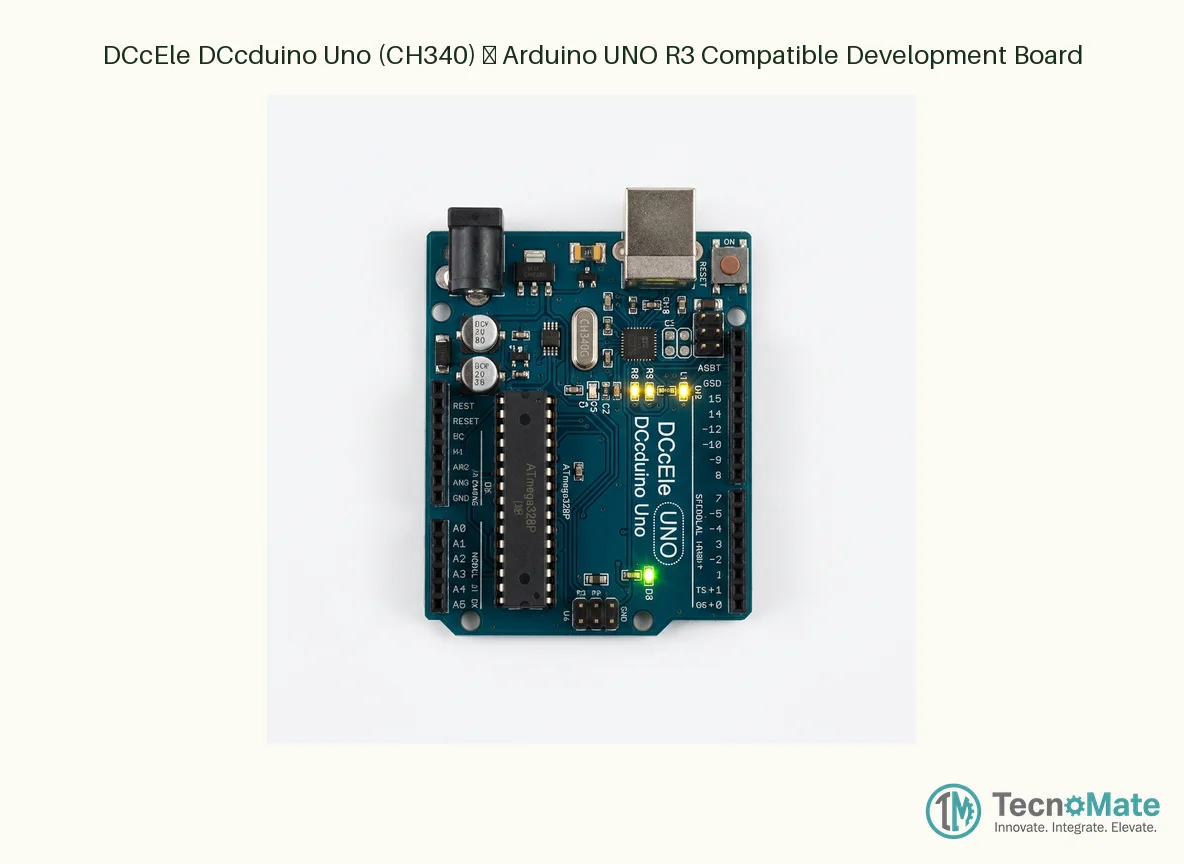
DCcEle DCcduino Uno (CH340) – Arduino UNO R3 Compatible Development Board
The DCcEle DCcduino Uno (CH340) is a full Arduino UNO R3 compatible development board built around the reliable ATmega328P microcontroller together with the cost-optimized CH340G USB-to-Serial bridge — giving you the exact same Arduino experience at a fraction of the price of a genuine board. It is 100% pin-compatible and software-compatible with the Arduino UNO R3: the same 14 digital I/O pins (6 capable of 8-bit PWM output), 6 analog inputs, ICSP header, reset button, and standard UNO shield footprint. Whether you are a student building your first blink sketch, a hobbyist prototyping a home-automation gadget, or an engineering student working on a final-year robotics project, this board delivers all the capability you need without straining your budget.
Instead of the expensive ATmega16U2 used on original Arduino UNOs, this board uses the CH340G USB-to-Serial converter — a proven, widely supported chip that is driver-compatible with Windows (7/8/10/11), macOS, and Linux. On Windows, a quick one-time driver install gets you up and running; on Linux and recent macOS, the CH340 is natively recognized. Once connected, the Arduino IDE sees it as a standard COM port, and you can program it just like a genuine Arduino.
The board runs on 5V logic and can be powered via the USB-B port or an external 7–12V DC adapter (barrel jack, 2.1 mm center-positive). Onboard 5V and 3.3V regulators supply power to your sensors and modules. The DCcduino Uno handles up to 20 mA per I/O pin and delivers 50 mA on the 3.3V rail — ample for standard LEDs, sensors, small servos, and LCDs.
Every unit is factory-flashed with the Arduino UNO bootloader, so it works straight out of the box with the Arduino IDE, PlatformIO, and Scratch-based programming tools like mBlock. Perfect for classrooms, training centres, and self-learners across India who need affordable, reliable microcontroller boards that don't compromise on capability.
₹349.00
Specifications
SRAM: 2 KB
EEPROM: 1 KB
Bootloader: Optiboot (Arduino UNO compatible)
Clock Speed: 16 MHz (ceramic resonator)
Flash Memory: 32 KB (0.5 KB used by bootloader)
Onboard LEDs: Power (green), Pin 13 (yellow), TX/RX (red)
USB Connector: USB-B (Type B)
USB-to-Serial: CH340G
PCB Dimensions: 68.6 × 53.4 mm (standard UNO)
Microcontroller: ATmega328P (DIP-28 package)
Power Connector: 2.1 mm barrel jack (center-positive)
Digital I/O Pins: 14 (6 provide 8-bit PWM output)
Analog Input Pins: 6 (10-bit ADC)
IDE Compatibility: Arduino IDE, PlatformIO, mBlock, S4A
Operating Voltage: 5V (logic level)
DC Current per I/O Pin: 20 mA
Input Voltage (limits): 6–20V
DC Current for 3.3V Pin: 50 mA
Input Voltage (recommended): 7–12V
Details
The DCcEle DCcduino Uno (CH340) belongs to the family of third-party Arduino UNO R3 clones that have democratized embedded electronics education across India. These boards emerged around 2014–2015 as the CH340G chip became widely available, allowing manufacturers to shave significant cost off the BOM while preserving full Arduino compatibility. Today, these CH340-based UNO boards are the backbone of countless Indian engineering college labs, maker spaces, embedded training institutes, and hobbyist workbenches.
What makes the DCcduino Uno special in a crowded clone market? Quality control. Many unbranded Chinese clones ship with cold solder joints, misaligned headers, or flaky USB connectors that fail after a few insertions. DCcEle has built a reputation for producing consistent, well-assembled boards with clean soldering, properly aligned female headers, and USB-B connectors that hold up to daily plugging and unplugging. The board also features a robust AMS1117 5V regulator and a dedicated 3.3V LDO, ensuring clean, stable power for your external modules.
For Indian buyers, this board hits the sweet spot: it costs roughly the same as two cups of coffee, yet it unlocks the entire Arduino ecosystem — thousands of open-source libraries, hundreds of shields, and a global community. You can use it to build a line-following robot, an automatic plant-watering system, a Bluetooth-controlled home appliance, an RFID attendance logger, a weather station with a DHT11 sensor, or even a basic oscilloscope. And because it's electrically identical to the genuine UNO R3, every tutorial, YouTube video, and Instructable you find online will work with this board without modification.
One important note: the CH340G chip requires a driver on Windows. Mac and Linux users are generally plug-and-play. On Windows, downloading the driver from the manufacturer's website or the CH340 driver package takes under two minutes. Once installed, the board appears as a COM port and works identically to any other Arduino. This minor setup step is the only difference from a genuine Arduino UNO, and it's a trade-off that saves you ₹1500 or more — money better spent on sensors, motors, and modules for your project.
The DCcduino Uno is also an excellent choice for bulk purchasers: training institutes, engineering colleges, and school STEM labs can buy dozens of these boards for the price of a handful of genuine Arduinos, making hands-on electronics education far more accessible. With the Indian government's push toward Atal Tinkering Labs and embedded-skills education, affordable, reliable boards like the DCcduino Uno are exactly what the ecosystem needs.
 Arduino Boards & Compatibles