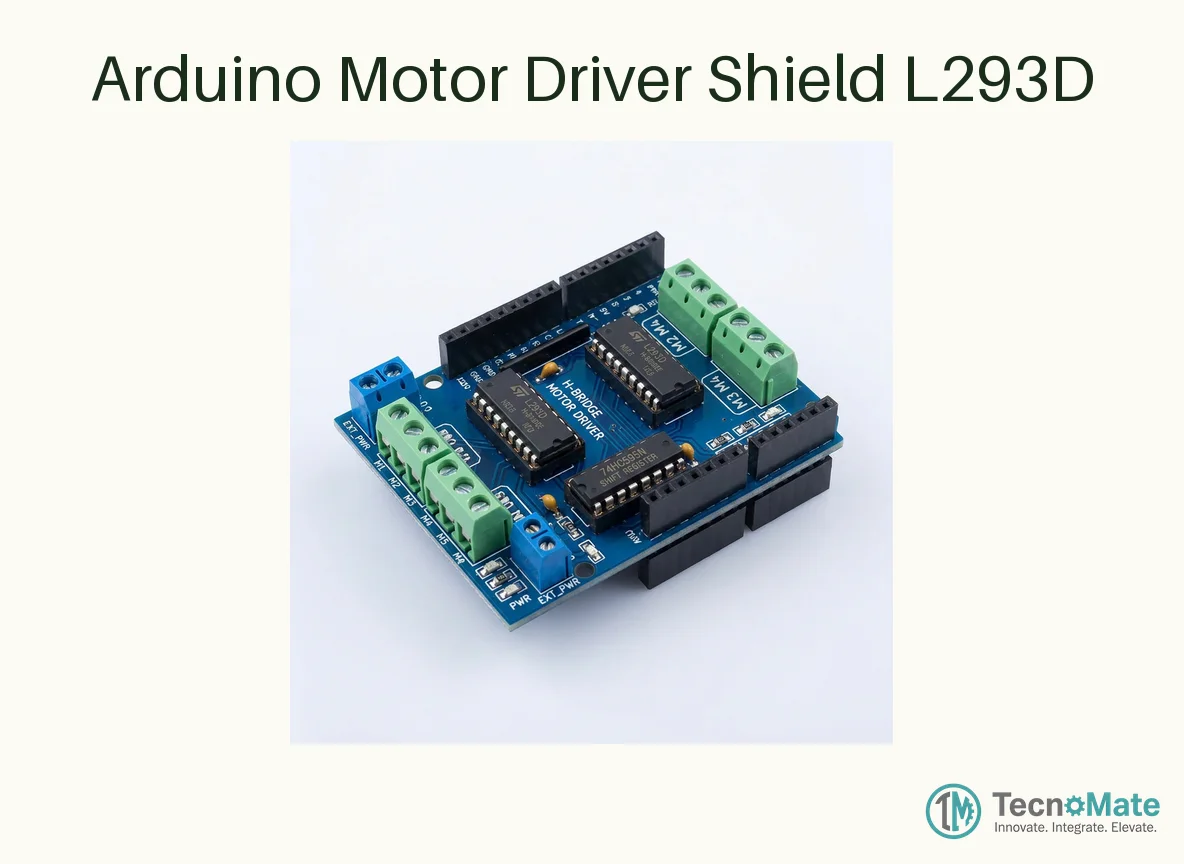
The Arduino Motor Driver Shield L293D is a compact, plug-and-play motor control expansion board designed to sit directly atop your Arduino UNO or Mega, instantly transforming it into a versatile robotics controller. Built around the trusted L293D quad half-H driver IC — supported by a 74HC595 shift register for efficient pin management — this shield can independently drive up to four bidirectional DC motors, two stepper motors, or two 5V hobby servos simultaneously. Whether you are building a line-following robot, an obstacle-avoiding rover, a CNC plotter, or an automated curtain system, this shield gives you the muscle to move things without messy breadboard wiring.
The L293D shield is ideal for engineering students, hobbyists, and educators across India who need a reliable, low-cost motor interface for their Arduino projects. It handles motor supply voltages from 4.5V to 25V, delivers up to 600mA continuous current per channel (1.2A peak), and includes onboard flyback diodes to protect your Arduino from inductive voltage spikes. The integrated 74HC595 shift register expands just 3 Arduino I/O pins into 8 control lines, conserving precious digital pins for sensors and other peripherals. Two dedicated servo headers provide direct 5V power and signal routing, with access to Arduino's high-resolution timer for jitter-free servo motion.
The shield supports PWM-based speed control on all four DC motor channels, making it easy to vary motor speed in code. Its pin usage (D3 through D12) is well-documented, and it is compatible with popular Arduino libraries like Adafruit Motor Shield Library, making programming straightforward even for beginners. The terminal block connectors accept stripped wire ends for secure motor connections, while the shield's pass-through headers allow stacking additional shields on top. Compact, robust, and well-supported by the global Arduino community, the L293D Motor Driver Shield is a must-have expansion board for anyone venturing into motorized Arduino projects.
₹190.00
Specifications
Weight: ~28 g
Compatibility: Arduino UNO R3, Arduino Mega 2560 (and compatible clones)
Servo Headers: 2 (5V hobby servos, standard 3-pin)
PCB Dimensions: ~69 mm × 53 mm (standard Arduino shield footprint)
Shift Register: 74HC595 (serial-in, parallel-out)
Motor Driver IC: L293D (quadruple half-H driver)
Arduino Pins Used: D3, D4, D5, D6, D7, D8, D9, D10, D11, D12
Control Interface: 3-pin serial (via 74HC595) + PWM pins
DC Motor Channels: 4 (bidirectional)
Onboard Protection: Flyback diodes, thermal shutdown
Logic Supply Voltage: 5V (from Arduino)
Motor Supply Voltage: 4.5V – 25V DC
Stepper Motor Support: Up to 2 stepper motors (unipolar or bipolar)
Peak Current per Channel: 1.2 A
Continuous Current per Channel: 600 mA
Details
If you have spent hours searching for an affordable, dependable motor driver that simply works with your Arduino UNO or Mega, the Arduino Motor Driver Shield L293D is the answer. This shield takes all the complexity of wiring an H-bridge circuit, managing flyback protection, and allocating microcontroller pins, and condenses it onto a single board that drops right onto your Arduino headers. No soldering, no breadboard spaghetti — just stack, connect your motors and power, and start coding.
Under the hood, the shield features the legendary L293D IC, a 16-pin quad half-H driver that has powered student robotics projects for decades. Why two L293D chips on many variants of this shield? Because one L293D can control two DC motors, and having a second chip doubles your capacity to four motors or two steppers — a configuration that covers the vast majority of educational and hobby robotics platforms. The onboard 74HC595 serial-to-parallel shift register is the unsung hero here: it takes serial data from just three Arduino pins and fans it out to eight parallel control lines. This intelligent pin-saving design means your Arduino still has analog pins and a handful of digital pins free for ultrasonic sensors, IR receivers, Bluetooth modules, or displays.
For Indian engineering students working on their final-year projects, this shield is particularly valuable. It is widely available across online marketplaces like Robocraze, MakerBazar, and Amazon India, typically priced between ₹130 and ₹250, making it one of the most budget-friendly motor interfaces available. It is compatible with the standard Arduino IDE and works with both the classic Arduino UNO R3 and the Arduino Mega 2560. The shield's motor power terminal block accepts an external DC supply (a 9V or 12V battery or adapter), keeping the high-current motor load isolated from the Arduino's 5V regulator. This isolation prevents brownouts and resets that plague poorly designed motor circuits.
Common projects that leverage this shield include Bluetooth-controlled robot cars, voice-controlled wheelchairs (prototype scale), automatic plant watering systems with motorized pumps, camera sliders, 3D printer axis drivers, and automated door openers. The shield's two servo headers are compatible with standard SG90 and MG995 servos, commonly used for pan-tilt mechanisms and robotic arms. With PWM-capable motor channels, you can smoothly ramp motor speeds up and down, simulating realistic acceleration and deceleration in your robot.
Installation is straightforward: align the shield with your Arduino's headers, press firmly, connect your external motor power supply (4.5V–25V DC) to the screw terminal, wire your motors to the M1–M4 terminal blocks, and optionally plug servos into the 3-pin servo headers. In software, install the Adafruit Motor Shield V1 library from the Arduino Library Manager, and you can have your first motor spinning within five minutes. Sample sketches for DC motor control, stepper motor rotation, and servo sweeping are readily available in the library examples, giving beginners a gentle learning curve while offering advanced users the performance they demand.


 Arduino Boards & Compatibles