Arduino Nano ESP32 – Official ABX00083 Development Board with ESP32-S3, Wi-Fi, Bluetooth 5.0 & USB-C
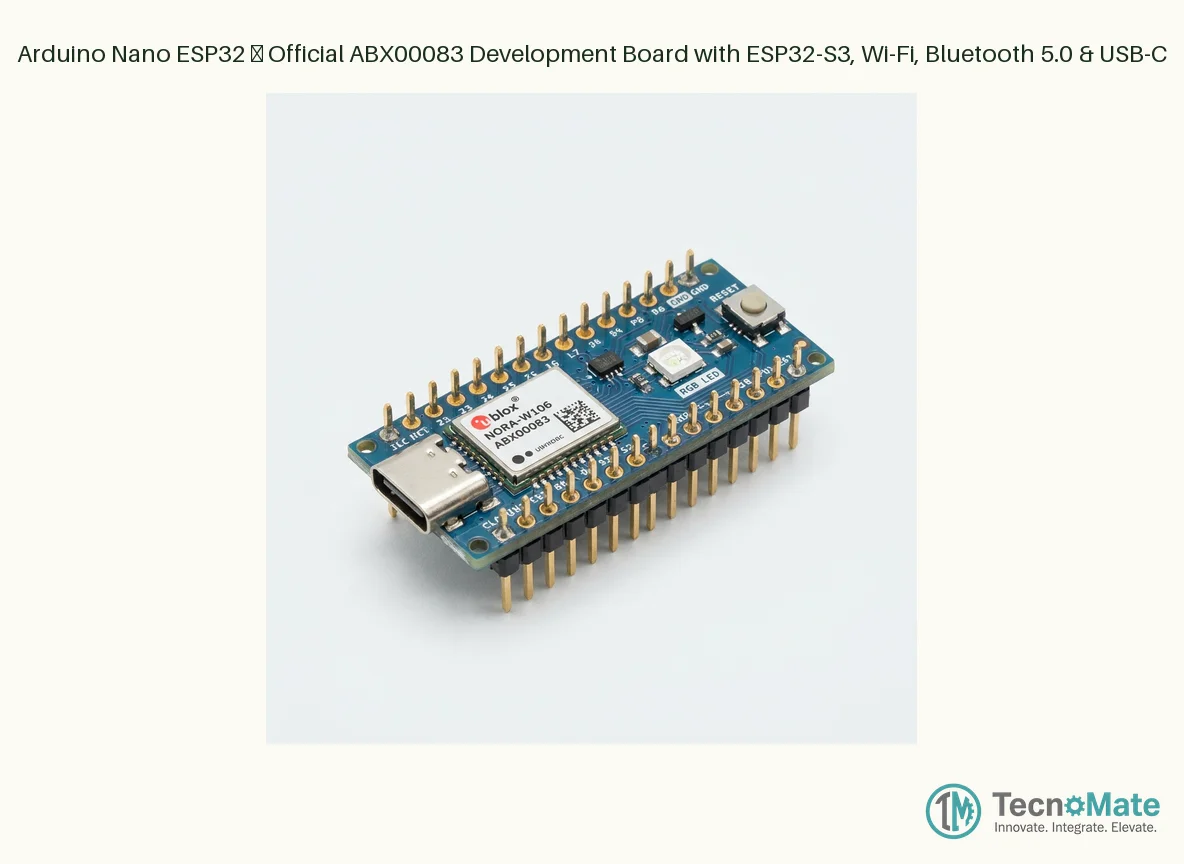
The Arduino Nano ESP32 (SKU: ABX00083) is the first official Arduino board to feature an ESP32 as its main processor, bringing together the trusted Arduino Nano form factor with the raw wireless power of the ESP32-S3. At its heart lies the u-blox NORA-W106 module, housing a dual-core Xtensa 32-bit LX7 processor clocked at up to 240 MHz, paired with 512 KB of SRAM, 384 KB of ROM, and a generous 16 MB (128 Mbit) of external flash memory — ample space even for complex IoT firmware, OTA update partitions, and MicroPython scripts.
Unlike generic ESP32 dev boards, this is a genuine Arduino product: it works seamlessly in the Arduino IDE (2.x), supports Arduino Cloud for remote dashboards and over-the-air updates, and is also fully compatible with MicroPython — making it equally appealing to Arduino loyalists and Python-curious embedded developers. The board retains the classic Nano pinout (45 mm × 18 mm), so it drops right into existing Nano projects and breadboards, but upgrades the USB connector to modern USB-C for data and power. On the wireless side, you get 2.4 GHz Wi-Fi (802.11 b/g/n) and Bluetooth 5.0 / BLE, enabling projects from low-power sensor meshes to full web-servers-on-a-chip.
With 14 digital I/O pins, 8 analog inputs, UART, SPI, I²C, and PWM on virtually every digital pin, the Nano ESP32 is versatile enough for motor control, sensor fusion, audio, and display driving. It also includes built-in RGB LED, a reset button, and a boot button for easy firmware flashing. Whether you're building a smart-home controller, a wearable BLE beacon, an IoT weather station that publishes to Arduino Cloud, or a robotics sensor node, the Nano ESP32 gives you certified wireless hardware in a breadboard-friendly package — backed by Arduino's vast library ecosystem and community.
₹2420.00
Specifications
ROM: 384 KB
SKU: ABX00083 (with headers) / ABX00092 (without headers)
USB: USB-C (programming & power)
SRAM: 512 KB
Wi-Fi: 2.4 GHz, 802.11 b/g/n (up to 150 Mbps)
Weight: ~7 g
Bluetooth: Bluetooth 5.0, BLE (Bluetooth Low Energy)
Processor: Xtensa 32-bit LX7 dual-core
Dimensions: 45 mm × 18 mm
Interfaces: UART, SPI, I²C, I2S
Programming: Arduino IDE 2.x, MicroPython, ESP-IDF
Built-in LED: RGB LED on D13
Max CPU Speed: 240 MHz
Certifications: CE, RoHS, REACH
External Flash: 16 MB (128 Mbit)
Microcontroller: u-blox NORA-W106 (ESP32-S3)
Digital I/O Pins: 14 (all PWM-capable)
Analog Input Pins: 8 (12-bit ADC)
Operating Voltage: 3.3 V (logic), 5 V (USB input)
Input Voltage (VIN): 6–21 V (recommended)
DC Current per I/O Pin: 40 mA
Details
The Arduino Nano ESP32 marks a significant milestone in Arduino's history — it is the first official Nano board to use an ESP32 as its main microcontroller. For years, makers and IoT developers had to choose between the polished Arduino ecosystem and the raw wireless capabilities of Espressif's ESP32 chips. The Nano ESP32 finally bridges that gap, offering the ESP32-S3's dual-core processing muscle and dual wireless radios inside Arduino's trusted, well-documented Nano form factor.
Under the hood, the board packs a u-blox NORA-W106 module built around the ESP32-S3 SoC. This chip features two Xtensa LX7 cores that can independently clock up to 240 MHz, giving you true multitasking capability — run Wi-Fi networking on one core and sensor polling on the other. 512 KB of on-chip SRAM and 16 MB of external flash mean you can store large firmware images, HTML/JavaScript for embedded web servers, multiple MicroPython scripts, and OTA update slots without worrying about space. The ESP32-S3 also includes hardware acceleration for cryptographic operations and vector instructions — useful for edge-AI and signal processing at the edge.
Connectivity is future-proofed with a USB-C port that handles both programming and power (5 V). Wireless is handled natively: 2.4 GHz Wi-Fi (b/g/n) and Bluetooth 5.0 with BLE. Arduino has put serious effort into the software stack — the board is fully supported in Arduino IDE 2.x with built-in board manager support, works with Arduino Cloud for remote device management, and has a dedicated MicroPython firmware maintained by Arduino themselves. This triple-mode programming support (C++ in Arduino IDE, MicroPython, and ESP-IDF for advanced users) makes the board uniquely flexible.
The physical design stays true to the beloved Nano footprint: 45 mm long, 18 mm wide, with two rows of 15 pins each. The pinout is intentionally designed to be compatible with existing Nano shields and breadboard layouts. You get 14 digital pins (all PWM-capable), 8 analog inputs, UART, SPI, I²C, and dedicated pins for I2S audio. The board also features a built-in RGB LED on pin D13, a reset button, and a boot button for easy flashing mode entry.
For India's growing IoT and embedded ecosystem, the Nano ESP32 is an ideal choice. Students at engineering colleges can use it for final-year projects involving Wi-Fi sensor networks, home automation, or BLE-based attendance systems. Hobbyists can build weather stations that upload to the cloud, smart plugs, or remote-controlled robots. Professional developers can prototype connected products quickly using Arduino Cloud's dashboards and OTA capabilities before moving to production. The official Arduino branding also means authentic CE/RoHS certification, reliable 3.3 V regulation, and consistent quality — important when you're deploying projects beyond the lab bench.


 Arduino Boards & Compatibles