TecnoMate logo
All Components
Prototyping & Breadboards

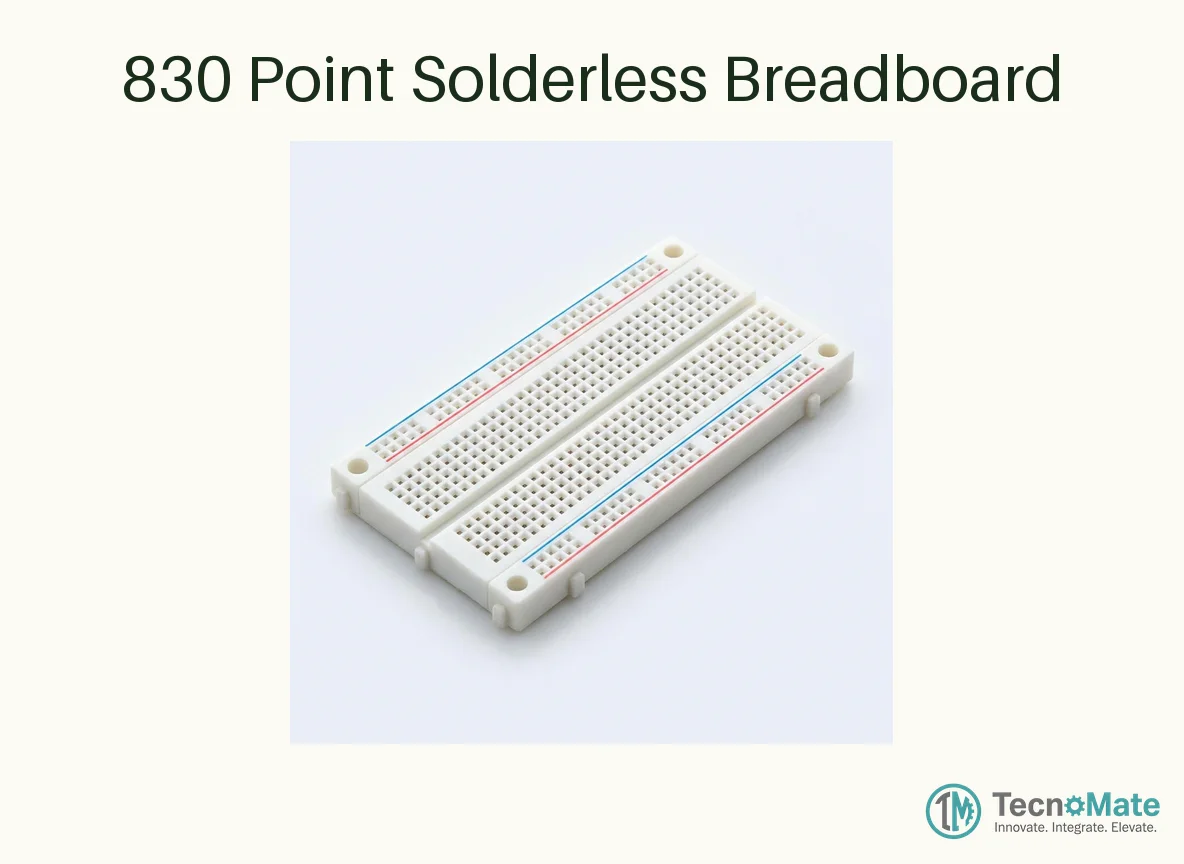
830 Point Solderless Breadboard

The 830 Point Solderless Breadboard is a full-size reusable prototyping board for building and testing electronic circuits without soldering. With 830 tie-points, dual power rails and standard 2.54 mm spacing, it is ideal for Arduino, Raspberry Pi Pico, ESP32, sensor modules, IC experiments and classroom labs. Makers, students, hobbyists and engineers can quickly plug in jumper wires, DIP ICs, resistors, LEDs and modules to validate circuit ideas before making a PCB.
830 Point Solderless Breadboard
₹105.00

Specifications

Layout: Central IC channel with side power distribution rails Material: Insulated plastic body with metal spring contacts Mounting: Adhesive backing and side interlocking tabs on common 830-point style boards Reusable: Yes, solderless plug-in design Hole pitch: 2.54 mm / 0.1 inch Product type: Solderless prototyping breadboard Total tie points: 830 Recommended current: Low-current signal and prototype use; keep high-current paths off the breadboard, typically ≤1A per contact/rail Compatible wire size: Typically 20-29 AWG solid jumper wire or male header pins Power rail tie points: 200 Approximate dimensions: 165 mm x 55 mm x 8-10 mm Suitable component pitch: Standard 0.1 inch through-hole parts and DIP ICs Terminal strip tie points: 630 Recommended operating voltage: Low-voltage DC prototyping such as 3.3V, 5V and 12V; not for mains AC


Details

Build circuits faster and cleaner with this 830 Point Solderless Breadboard, a must-have prototyping platform for electronics learning, embedded development and DIY projects. It provides a standard 2.54 mm pitch layout compatible with most through-hole components, DIP IC packages, male header pins and breadboard jumper wires. Because it is solderless, components can be inserted, removed and reused repeatedly, making it perfect for testing ideas before committing to soldering or PCB fabrication. The board is arranged as a central terminal area with a divider gap for placing integrated circuits, plus power distribution rails on both sides. The 830 tie-points typically include 630 interconnected terminal points for circuit building and 200 points for supply rails, allowing convenient distribution of 3.3V, 5V, GND or other low-voltage project supplies. Rows of five holes are internally connected in the main area, while the long side rails are used for power and ground connections. Many 830-point boards also include an adhesive backing and interlocking tabs so multiple breadboards can be joined for larger circuits. Use it for Arduino Uno and Nano experiments, ESP8266/ESP32 IoT prototypes, Raspberry Pi Pico circuits, basic transistor and op-amp tests, LED/resistor networks, sensor interfacing, motor-driver logic testing, timer IC projects and educational electronics labs. It is best suited for low-voltage, low-current prototyping; avoid mains voltage and high-current loads on solderless breadboards. What you get: one 830-point solderless breadboard. Pin notes: use solid-core jumper wire or breadboard-compatible male pins, commonly 20-29 AWG. DIP ICs should be placed across the centre gap so each pin connects to a separate row. Power rails may be split on some boards, so check continuity before powering your circuit.

Tags

breadboardprototypingsolderlessArduinoESP32Raspberry Pi PicoDIY electronicslab equipment

Alternatives

  • MB-102 830 Point Breadboard
  • 400 Point Solderless Breadboard
  • 170 Point Mini Breadboard
  • Half Size Solderless Breadboard
  • Breadboard with Power Supply Module Kit