Arduino Boards & Compatibles
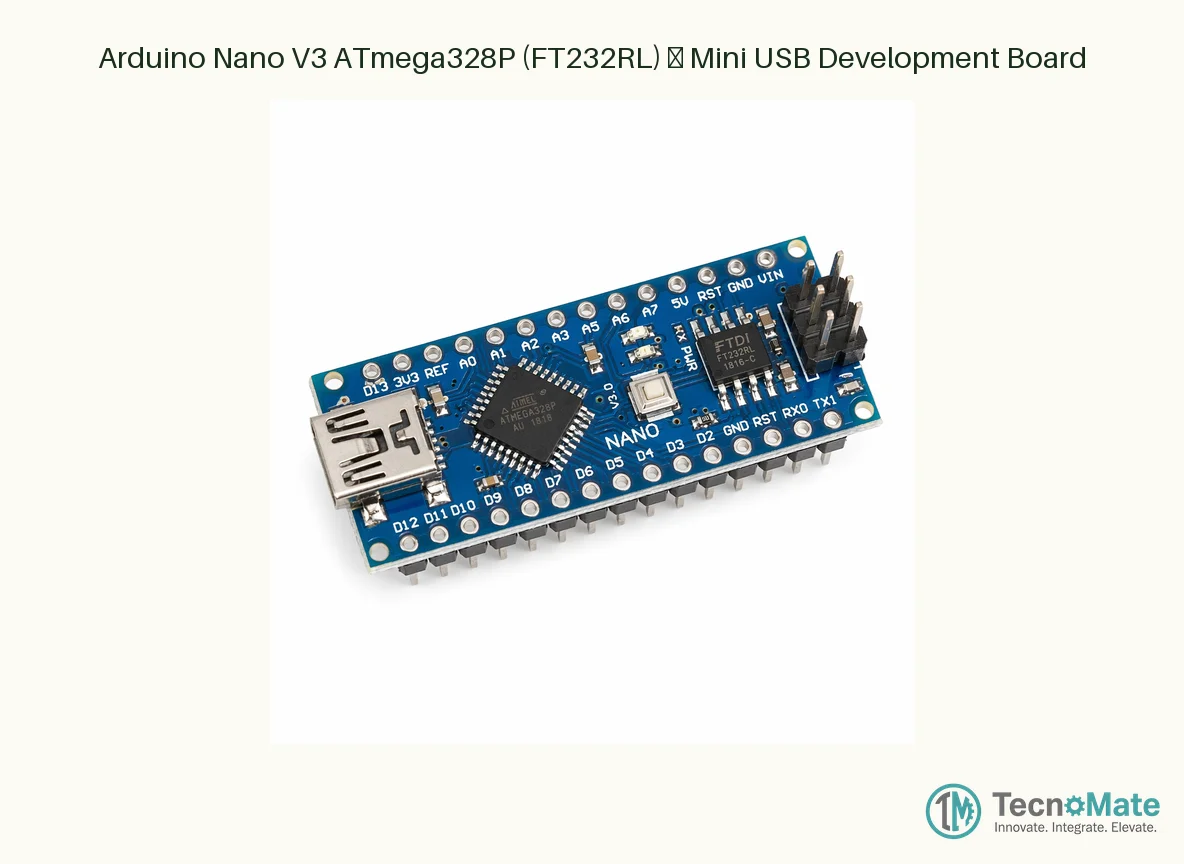
Arduino Nano V3 ATmega328P (FT232RL) — Mini USB Development Board
The Arduino Nano V3 is a compact, breadboard-friendly microcontroller development board built around the legendary ATmega328P chip. This specific variant uses the genuine FTDI FT232RL USB-to-Serial converter — a critical differentiator from cheaper CH340G clones. The FT232RL chip delivers rock-solid driver stability across Windows, macOS, and Linux, with zero hassle: plug it in and it just works. No hunting for unsigned drivers, no COM port disappearing mid-upload. For Indian engineering students, hobbyists, and embedded developers who value reliability over saving a few rupees, this is the Nano to buy.
Measuring just 45mm × 18mm and weighing under 7 grams, the Nano packs the same processing power as an Arduino Uno into a fraction of the footprint. It drops straight into a standard 830-point breadboard with room to spare on both sides — perfect for prototyping sensor arrays, motor drivers, and IoT nodes. You get 14 digital I/O pins (6 PWM-capable), 8 analog inputs with 10-bit resolution, hardware SPI/I²C/UART, and a 16 MHz crystal oscillator. The board runs on 5V logic and accepts 7–12V through its VIN pin or straight 5V via the Mini USB port.
Whether you're building a line-following robot for a college competition, a home automation node, a wearable health monitor, or a DIY drone flight controller, the Nano's tiny size and full Arduino ecosystem support make it the go-to board. It programs through the familiar Arduino IDE — just select "Arduino Nano" from the boards menu, pick the ATmega328P (Old Bootloader) processor, and you're ready to upload. The FT232RL chip also enables seamless serial monitoring, which is invaluable for debugging sensor data and tuning PID loops.
This board is extensively used in Indian engineering colleges — from first-year hobby projects to final-year capstone designs. Its 32 KB of flash (2 KB for the bootloader), 2 KB of SRAM, and 1 KB of EEPROM give you enough headroom for substantial sketches. Stack it with sensor shields, relay modules, or motor drivers available right here at TecnoMate, and you have a complete prototyping platform that fits in your pocket.
Specifications
SRAM: 2 KB
EEPROM: 1 KB
Weight: ~7 g
PCB Color: Blue
Bootloader: Optiboot (Old Bootloader)
Dimensions: 45 mm × 18 mm × ~7 mm (with headers)
Clock Speed: 16 MHz
Flash Memory: 32 KB (2 KB used by bootloader)
USB Connector: Mini USB (Type-B Mini)
USB-to-Serial: FTDI FT232RL (genuine)
Microcontroller: ATmega328P
Digital I/O Pins: 14 (6 PWM: D3, D5, D6, D9, D10, D11)
Analog Input Pins: 8 (A0–A7, 10-bit ADC)
Operating Voltage: 5V
Input Voltage (VIN): 7–12V (recommended), 6–20V (absolute limits)
DC Current per I/O Pin: 40 mA
Details
Looking for a reliable Arduino Nano that doesn't fight you on drivers? The FT232RL variant is what professionals and serious students choose. Here's the full breakdown.
When you're deep into a project at 2 AM and your board stops responding, the last thing you want is a driver issue. That's where the FT232RL makes all the difference. Unlike the CH340G chip found on budget Nano clones, FTDI's FT232RL has been the industry gold standard for USB-to-Serial conversion for over a decade. Microsoft ships WHQL-certified drivers for it in Windows Update. macOS recognizes it natively. On Linux, the ftdi_sio kernel module loads automatically. This means you spend time writing code, not troubleshooting COM ports.
The ATmega328P at the heart of this board is one of the most battle-tested microcontrollers in the world. With 32 KB of ISP flash memory, you can comfortably run multi-sensor fusion algorithms, implement communication protocols, and still have room for a bootloader. The 2 KB of SRAM may sound modest, but careful programming lets you buffer sensor data, manage display framebuffers, and handle wireless module communication without hitting the ceiling.
What really sets the Nano apart from larger boards like the Uno is its breadboard compatibility. All 30 pins are brought out to standard 2.54mm pitch male headers on the underside. You can solder female headers and plug it directly into a breadboard, or use it as a pluggable module on a custom PCB. Indian robotics clubs frequently use Nanos as dedicated motor-control nodes distributed around a chassis — one per wheel — communicating over I²C with a central controller.
Power flexibility is another strength. The onboard 5V regulator (usually an AMS1117-5.0 or similar LDO) accepts 7–12V on the VIN pin, letting you power the Nano from a 9V battery, a 2S/3S LiPo, or a wall adapter. The Mini USB port provides a regulated 5V rail directly — clean and stable for sensitive analog readings. There's also a 3.3V output pin (sourced from the FT232RL's internal regulator) for powering low-voltage sensors and modules.
The Nano V3 pinout includes:
- D0–D13: 14 digital I/O pins
- D3, D5, D6, D9, D10, D11: 6 PWM outputs (8-bit)
- A0–A7: 8 analog inputs (10-bit ADC)
- A4 (SDA) and A5 (SCL): I²C bus
- D10 (SS), D11 (MOSI), D12 (MISO), D13 (SCK): SPI bus
- D0 (RX) and D1 (TX): Hardware UART
- RST: Reset pin (pull LOW to reset)
- VIN, 5V, 3.3V, GND (×2): Power rails
- AREF: Analog reference voltage
For Indian buyers, this board is compatible with every accessory in the TecnoMate catalog: ultrasonic sensors (HC-SR04), servo motors (SG90, MG995), DC motor drivers (L298N, L293D), relay modules, Bluetooth modules (HC-05, HC-06), OLED displays (SSD1306), and all standard Arduino shields. The Mini USB cable required for programming is widely available — you probably already have one from an old digital camera or MP3 player.
One note for beginners: the ATmega328P bootloader on this variant is typically the "old" Optiboot bootloader. In the Arduino IDE, select "Tools → Processor → ATmega328P (Old Bootloader)" for reliable uploads. If you see "avrdude: stk500_getsync(): not in sync" errors, double-check this setting and your COM port before troubleshooting hardware.
In summary: if you want a Nano that works first time, every time, choose the FT232RL variant. It's the board that Indian engineering faculty recommend, robotics labs standardize on, and seasoned makers keep a dozen of in their component bins.