TecnoMate logo
All Components
Buzzers & Sound Modules

Piezo Buzzer Element for Arduino

Piezo Buzzer Element for Arduino is a compact passive piezoelectric sound transducer used to generate beeps, alarms and simple musical tones from a microcontroller PWM or square-wave output. Ideal for Arduino, ESP32, Raspberry Pi Pico and basic electronics projects, this low-current buzzer element converts electrical pulses into audible sound without a bulky speaker. It is perfect for makers, students, robotics builders and repair technicians who need an inexpensive alert sound component.
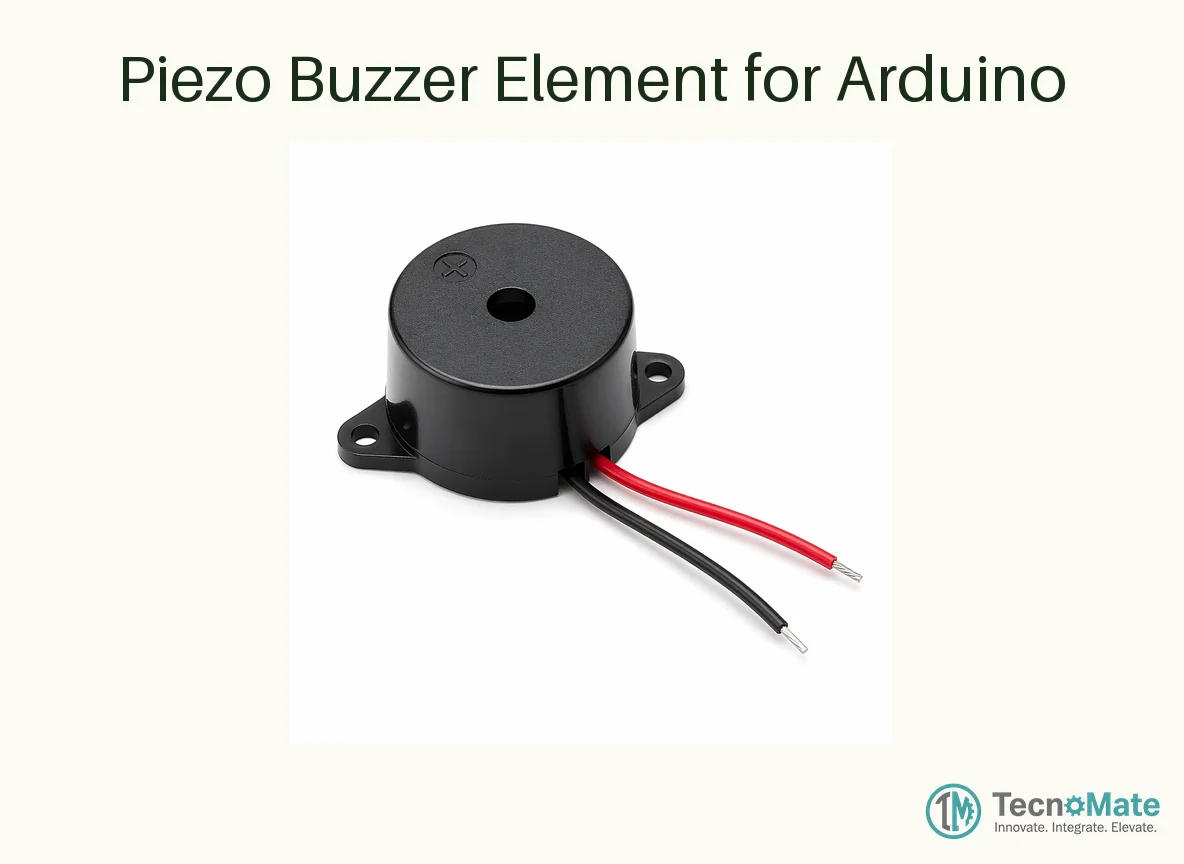
Piezo Buzzer Element for Arduino
₹21.00

Specifications

material: Piezo ceramic bonded to brass diaphragm mounting: Panel, enclosure, adhesive or mechanical clamp mounting polarity: Non-critical for basic buzzer tone generation interface: 2-terminal direct drive, PWM or digital output drive_type: External square wave or PWM required sound_output: Depends on drive voltage, frequency and mounting surface component_type: Passive piezoelectric buzzer / piezo sound element typical_diameter: Approx. 20mm to 27mm depending on supplied batch arduino_connection: One terminal to digital/PWM pin, other terminal to GND; use driver transistor for louder output resonant_frequency: Approximately 3kHz to 5kHz typical, depending on disc size and batch current_consumption: Very low, typically under 5mA when driven from microcontroller PWM maximum_drive_voltage: Up to 30V peak-to-peak typical for piezo disc elements compatible_logic_voltage: 3.3V and 5V microcontroller drive supported for low-volume beeps recommended_drive_voltage: 3V to 15V peak-to-peak typical


Details

This Piezo Buzzer Element for Arduino is a passive piezoelectric sounder designed for simple audio indication in embedded electronics projects. Unlike an active buzzer, a passive piezo element does not contain an internal oscillator; it produces sound only when driven with an AC signal, PWM signal or rapidly toggled digital output. This makes it very useful when you want to control tone frequency, beep duration, melodies or alarm patterns directly from Arduino code. The element works on the piezoelectric effect: a ceramic piezo disc flexes when voltage is applied, creating vibrations that are heard as sound. Because it behaves mainly like a capacitive load, it requires very little current compared with magnetic buzzers or speakers. For basic Arduino use, connect one lead to a PWM-capable digital pin through a small series resistor if desired, and the other lead to GND. Use the Arduino tone() function or a square-wave output to generate audible notes. For louder output or higher-voltage driving, use a transistor driver instead of powering it directly from a microcontroller pin. This piezo buzzer element is commonly used in Arduino alarm systems, keypad feedback, timers, DIY continuity testers, robotics status alerts, school STEM projects and compact electronic gadgets. It is also useful as a basic vibration or knock sensor when connected to an analog input with proper protection, although its main use is as a sound output element. The product is supplied as a bare passive piezo buzzer element with two connection leads or solder points, depending on batch. Polarity is generally not critical for tone generation, but the centre ceramic electrode and outer brass plate are the two terminals. Mounting the disc on a resonant surface or inside a small enclosure can significantly improve loudness.

Tags

buzzerpiezoarduinopassive-buzzersoundalarmroboticsstem

Alternatives

  • 5V Active Buzzer Module
  • Passive Buzzer Module for Arduino
  • Magnetic Buzzer 5V
  • 27mm Piezo Disc Sensor
  • KY-006 Passive Buzzer Module