Prototyping & Breadboards
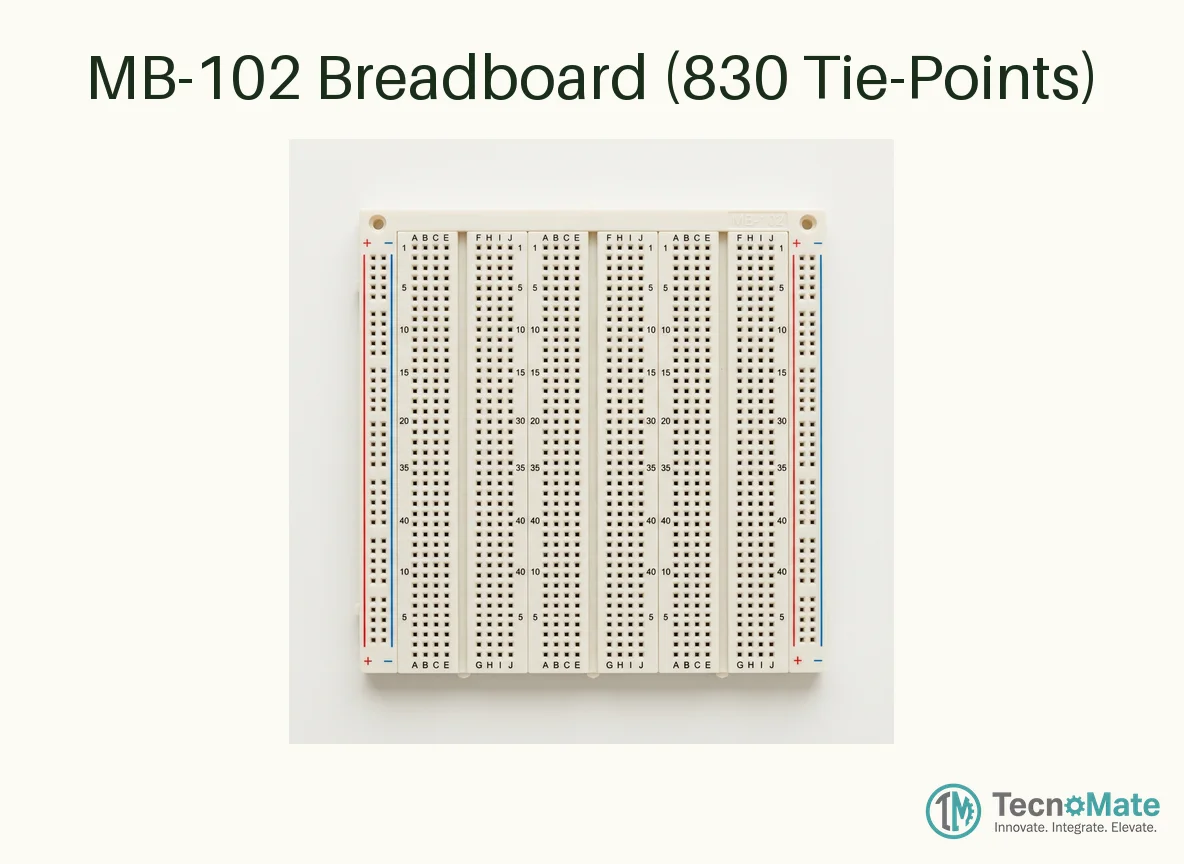
MB-102 Breadboard (830 Tie-Points)
The MB-102 Breadboard is a full-size 830 tie-point solderless prototyping board for quickly building and testing electronic circuits without PCB fabrication or soldering. With a 630-point terminal area, 200-point power distribution rails, and support for 20–29 AWG jumper wires, it is ideal for Arduino, ESP32, Raspberry Pi electronics, sensor modules, LED circuits, IC experiments, and classroom labs. A reusable must-have breadboard for students, makers, engineers, and repair benches.
Specifications
Model: MB-102 / MB102
Reusable: Yes, for temporary circuit prototyping
Power rails: 2 distribution strips, 200 tie points total
Product type: Solderless prototyping breadboard
Current rating: Not specified; use for low-current breadboard circuits only
Total tie points: 830
Operating voltage: Not specified by MB-102 generic manufacturers; intended for low-voltage electronics prototyping
Main matrix layout: 30 rows x 10 columns
Soldering required: No
Compatible wire size: 20 AWG to 29 AWG solid-core wire or standard jumper wires
Approximate dimensions: 16.5 cm x 5.5 cm x 0.85 cm
Terminal strip tie points: 630
Interface / connection method: Spring contact tie-point sockets
Power distribution tie points: 200
Details
The MB-102 830 Tie-Point Solderless Breadboard is one of the most widely used prototyping boards for electronics learning, circuit testing, and embedded development. It allows you to plug in components and jumper wires directly, make temporary connections, modify circuits, and reuse the board again and again—without soldering. This makes it perfect for beginners as well as experienced engineers who need a fast, reliable way to validate a circuit before moving to perfboard or PCB design.
The board provides 830 total tie points: a 630-point main terminal strip arranged as a 30 x 10 matrix, plus 200 tie points on the side power distribution rails. The central groove is suitable for DIP ICs and modules, allowing pins on either side of an IC to be isolated for neat wiring. The power rails are useful for distributing VCC and GND across the circuit when working with Arduino boards, microcontrollers, sensors, LEDs, resistors, transistors, op-amps, logic ICs, and small power modules.
The MB102 breadboard accepts solid-core hookup wire and standard jumper wires in the 20 to 29 AWG range, making it compatible with common male-to-male DuPont jumper cables used in hobby electronics. Its full-size layout gives enough workspace for multi-component experiments while remaining compact enough for a student toolkit or electronics workbench.
Typical projects include Arduino sensor interfacing, ESP8266/ESP32 development, LED and resistor experiments, 555 timer circuits, transistor switching, logic gate testing, analog amplifier prototypes, and classroom electronics demonstrations. This product page is for one MB-102 830 point solderless breadboard. Use it with jumper wires, a regulated power supply, and suitable components according to your circuit requirements.