Arduino Motor Shield L298P Rev3 – Dual DC & Stepper Motor Driver
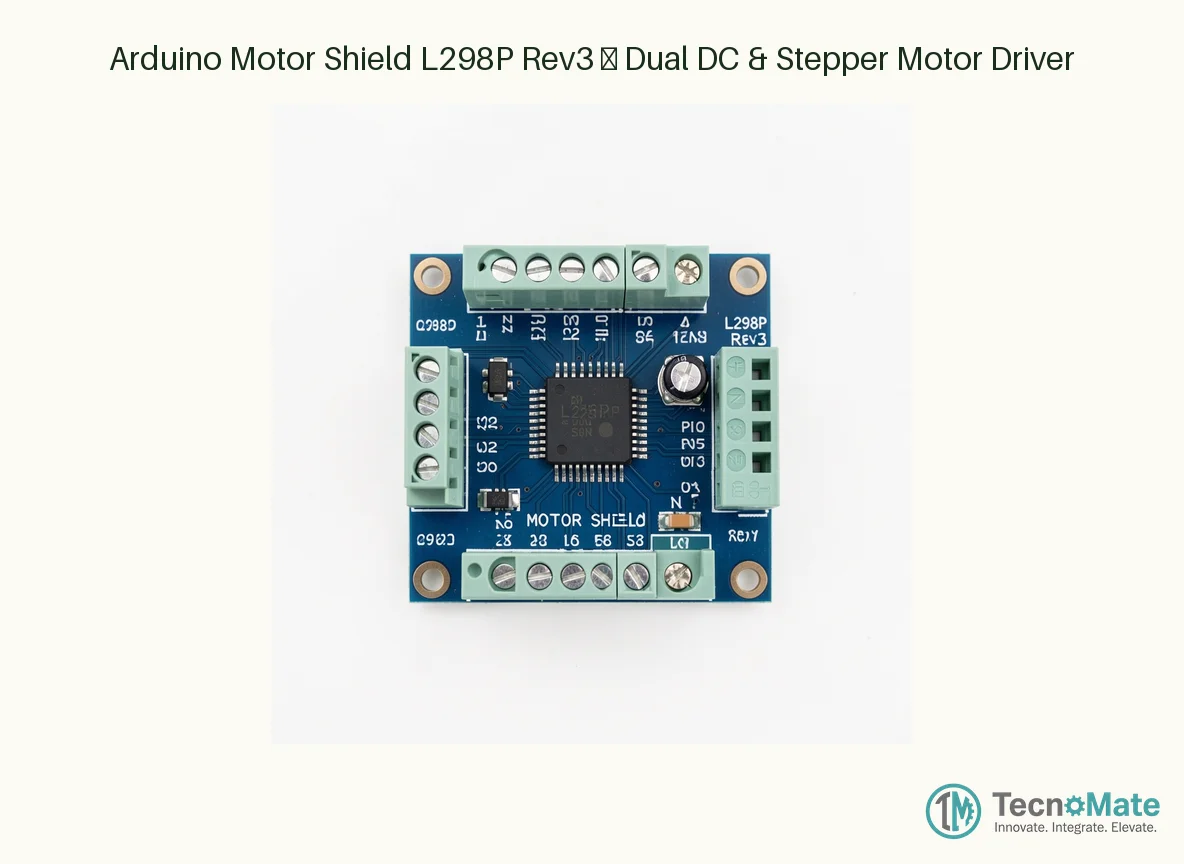
The Arduino Motor Shield L298P Rev3 is an Arduino-form-factor stackable motor driver board built around the proven L298P dual full-bridge driver IC. It lets you drive two independent brushed DC motors with full PWM speed and direction control — or one bipolar stepper motor — by simply plugging it on top of your Arduino Uno, Mega 2560, or Leonardo. No jumper-wire clutter, no external H-bridge modules: just stack, connect your motors to the onboard screw terminals, and start coding.
Designed for students, hobbyists, and prototyping engineers across India, this shield accepts a motor supply of 5 V to 12 V DC via the onboard 2.1 mm barrel jack or Vin screw terminal, delivering up to 2 A peak per channel (4 A total with an adequate external power supply and proper thermal conditions). An onboard jumper-selectable 5 V regulator can power the Arduino itself from the motor supply — eliminating the need for a second wall adapter during standalone operation.
Current-sensing pins (A0 for Channel A, A1 for Channel B) let your sketch read motor current in real time, enabling stall detection, torque limiting, and closed-loop control in advanced robotics projects. Every unused Arduino I/O pin is passed through to female stacking headers, so you can still access free pins or stack another shield (LCD, sensor, XBee) on top. Direction-indicator LEDs per channel and a power LED give instant visual feedback during debugging.
Whether you're building a Bluetooth rover for a college tech fest, an automatic curtain opener for a smart-home demo, a camera slider for content creation, or a mini CNC plotter for your engineering capstone project, this shield delivers reliable motion control in a tidy, well-documented package. Works out of the box with the Arduino Stepper library and the popular AFMotor library — get your motors spinning within minutes.
₹370.00
Specifications
Weight: ~30 g
PWM Pins: D3 (Channel A), D11 (Channel B)
Driver IC: L298P (SMD dual full-bridge)
Dimensions: ~68.6 mm × 53.3 mm × 20 mm
Logic Voltage: 5V (from Arduino)
Direction Pins: D12, D13 (Channel A); D8, D9 (Channel B)
LED Indicators: Power LED, 2× direction LEDs
Current Sensing: A0 (Channel A), A1 (Channel B)
Brake Pin (Ch A): D9
Brake Pin (Ch B): D8
Stacking Headers: Yes – all unused I/O pass-through
Compatible Boards: Arduino Uno R3, Mega 2560, Leonardo
Max Total Current: 4A (with external power & adequate cooling)
Onboard Regulator: 5V (jumper-selectable to power Arduino)
Onboard Connectors: 2.1mm barrel jack, Vin screw terminal, 4× motor screw terminals
Motor Supply Voltage: 5V – 12V DC (recommended)
Max Current Per Channel: 2A peak
Details
Looking for a plug-and-play motor driver for your Arduino Uno or Mega? The Arduino Motor Shield L298P Rev3 is one of the most popular choices among Indian engineering students, robotics hobbyists, and IoT makers. Unlike generic L298N modules that require a tangle of jumper wires, this shield stacks directly onto your Arduino, giving you a clean, compact, and mechanically solid assembly. It uses the surface-mount L298P IC — the same dual H-bridge architecture as the classic L298N, in a smaller SMD package with excellent thermal characteristics.
The shield independently controls two DC motors with direction and PWM speed (pins D3 and D11), or drives a single bipolar stepper motor by combining both channels. Motor power enters through the onboard 2.1 mm barrel jack or the Vin screw terminal, accepting 5 V to 12 V DC — perfect for common 7.4 V Li-Po packs, 9 V batteries, or a 12 V bench supply. An onboard jumper-configurable 5 V regulator can feed the Arduino from the motor supply, so your project can run standalone with a single power source.
What sets this shield apart for academic and prototyping use is the current-sensing feature. Each channel's motor current is routed to analog pins A0 and A1, letting your Arduino sketch monitor load in real time. This opens the door to closed-loop torque control, stall detection, and energy-optimised path planning — great for final-year engineering projects that need to demonstrate real-world sensing concepts.
Stacking headers pass all unused Arduino pins through to the top, so you can still plug in an LCD shield, sensor shield, or XBee adapter. Direction indicator LEDs (one per channel) make bench debugging quick and intuitive. The screw terminals accept wires up to AWG 18, providing a secure, solderless connection to your motors.
Common India use cases include: building a WiFi or Bluetooth-controlled robot car for college competitions, making an automated greenhouse vent opener for agricultural IoT projects, constructing a DIY camera slider for film-making, or assembling a pen plotter / mini CNC machine as a mechatronics capstone. The shield works out of the box with the standard Arduino Stepper library and popular community libraries like AFMotor — so you can get your motors spinning within minutes of unboxing.
With its Arduino Rev3 form factor, robust L298P heart, and student-accessible pricing, this motor shield is a must-have in every Indian maker's component drawer. Whether you're learning embedded systems for the first time or prototyping a commercial product, it delivers dependable, well-documented motion control that scales from classroom to competition.


 Arduino Boards & Compatibles