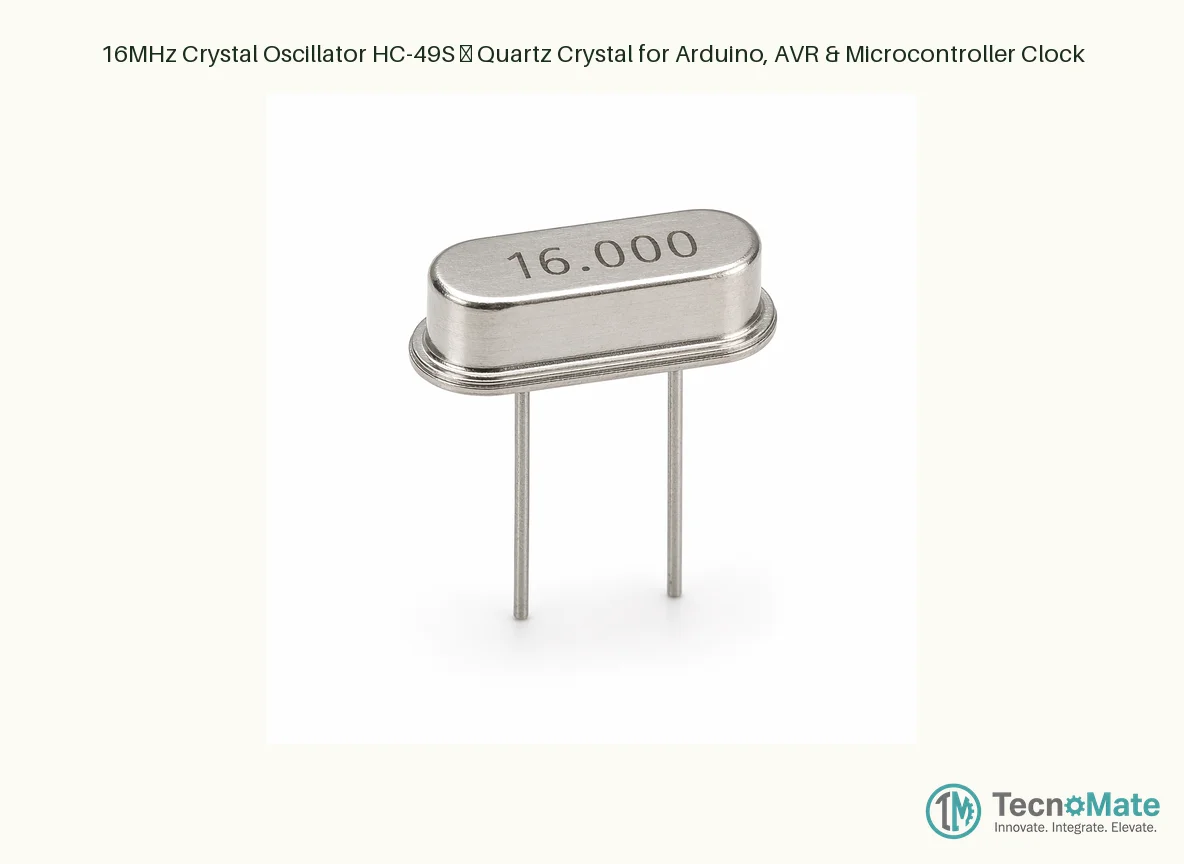
The 16MHz Crystal Oscillator in the HC-49S package is a fundamental timing component for digital electronics and microcontroller circuits. This quartz crystal provides a precise 16.000 MHz clock signal that serves as the heartbeat for your microcontroller projects. It is the exact same frequency used by the Arduino Uno (ATmega328P), Arduino Nano, and countless AVR-based development boards, making it an essential spare or prototyping part for every electronics enthusiast, engineering student, and IoT hobbyist in India.
The HC-49S is a low-profile, through-hole package that is easy to solder onto perfboards, stripboards, and custom PCBs. Unlike the taller HC-49/U variant, the HC-49S sits closer to the board, saving vertical space in compact enclosures. This crystal works with the internal Pierce oscillator circuit built into most microcontrollers — simply connect it across the XTAL1 and XTAL2 pins with two load capacitors (typically 22pF each) and your MCU will run at a rock-solid 16 MHz.
Why keep a few of these in your component bin? Crystals can get damaged from physical shock, overheating during soldering, or electrostatic discharge. If your Arduino suddenly stops responding or behaves erratically, a dead crystal could be the culprit. Swapping in a fresh HC-49S 16MHz crystal is a quick, low-cost repair that can bring a dead board back to life. These crystals are also perfect for building standalone ATmega328P circuits on a breadboard — the classic "breadboard Arduino" project that every Indian engineering student tackles in their second or third year.
Beyond Arduino, the 16MHz HC-49S is used in digital clocks, frequency counters, RF circuits, USB-to-serial converters, and any application that demands a stable, accurate timebase. TecnoMate sources these crystals from reliable manufacturers with tight frequency tolerance so your projects run reliably, semester after semester.
₹16.00
Specifications
Aging: ±5ppm per year (max)
Frequency: 16.000 MHz
Pin Pitch: 4.88mm (standard through-hole)
Dimensions: Approx. 11.5mm x 5.0mm x 3.5mm (L x W x H)
Drive Level: 100µW (typical)
Package Type: HC-49S (Low-Profile)
Mounting Type: Through-Hole (THT)
Frequency Stability: ±30ppm over -20°C to +70°C
Frequency Tolerance: ±20ppm to ±30ppm (at 25°C)
Insulation Resistance: ≥500 MΩ at 100V DC
Load Capacitance (CL): 18pF – 20pF (typical)
Shunt Capacitance (C0): 7pF max
Storage Temperature Range: -40°C to +85°C
Operating Temperature Range: -20°C to +70°C
Equivalent Series Resistance (ESR): 40Ω max (fundamental mode)
Details
Looking for a reliable 16MHz crystal oscillator for your Arduino or AVR microcontroller project? The HC-49S 16.000 MHz quartz crystal is one of the most widely used clock sources in DIY electronics. Whether you are repairing a dead Arduino Uno, building a standalone ATmega328P circuit on a breadboard, or designing a custom embedded system for your engineering final-year project, this crystal delivers the precise, stable clock signal your microcontroller needs.
What makes the HC-49S special? It is the low-profile version of the classic HC-49 package — same reliable quartz technology, but in a shorter can that fits better in tight spaces. With a typical frequency tolerance of ±20ppm to ±30ppm, your microcontroller's timing will be accurate enough for UART serial communication (where baud rate depends on the clock), PWM generation, timer interrupts, and I2C/SPI peripheral communication.
Installation is straightforward: solder the two leads of the crystal to the XTAL1 and XTAL2 pins of your ATmega328P, ATmega8, ATmega16, ATtiny85, or any compatible microcontroller. Then connect two ceramic capacitors (typically 18pF to 22pF) from each crystal pin to ground. That is it — your MCU now has a stable external clock. No configuration registers, no firmware changes needed. The crystal oscillates purely based on its piezoelectric properties.
This component is also a fantastic teaching tool. If you are an electronics instructor or a student learning about oscillators, the HC-49S crystal lets you visualize and measure the piezoelectric effect. Connect it to an oscilloscope probe and watch the sinusoidal 16MHz waveform. Use it with a 74HC4060 ripple counter to divide the frequency down to audible or visible ranges. The learning possibilities are endless.
At TecnoMate, we understand that Indian students and hobbyists need components that are affordable, genuine, and available quickly. Our 16MHz HC-49S crystals are priced competitively and checked for basic functionality before shipping. Stock up on a few — they are small, inexpensive, and you never know when you will need a spare crystal for that late-night project debugging session before the submission deadline.
Common troubleshooting tip: If your microcontroller is not starting up, check the crystal connections first. Cold solder joints on the crystal pins are among the most common causes of "dead" microcontroller boards. Reflow the solder, ensure the load capacitors are the correct value, and the crystal should spring to life.


 Arduino Boards & Compatibles