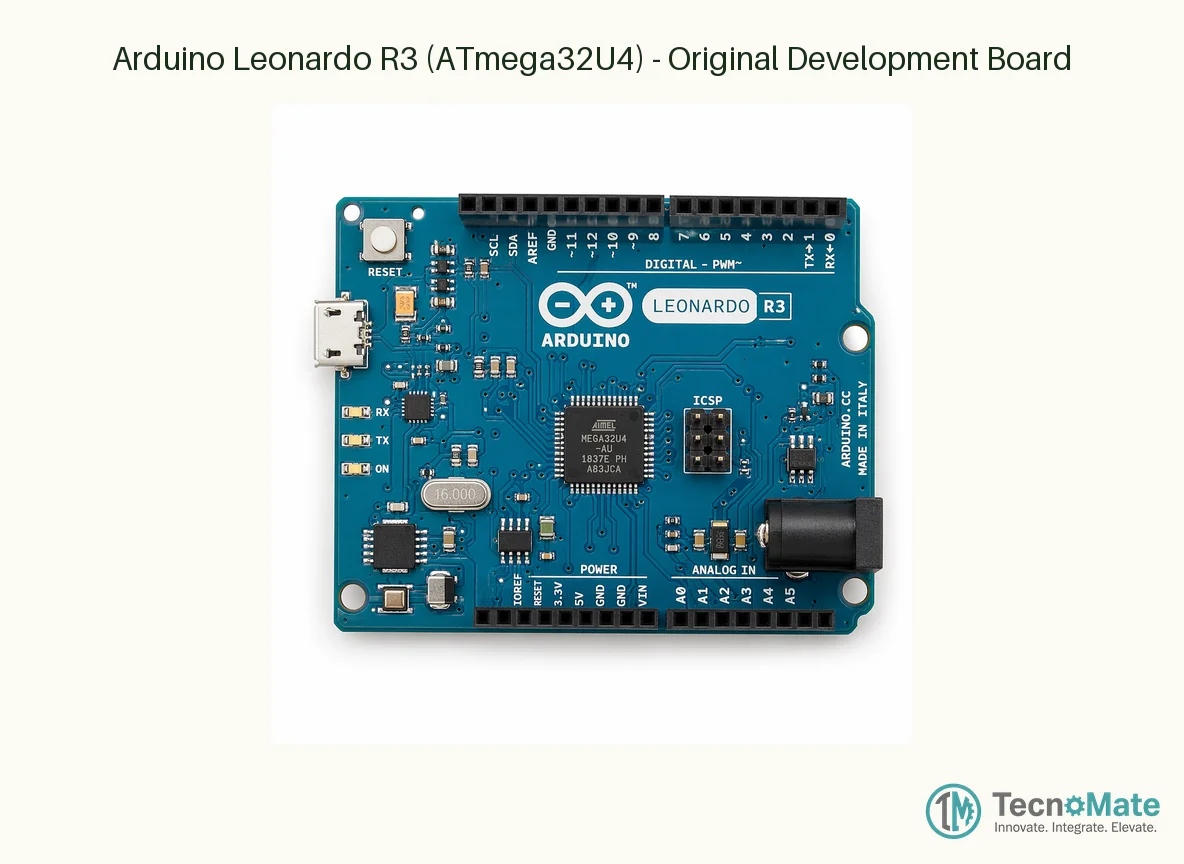
Arduino Leonardo R3 (ATmega32U4) - Original Development Board
The Arduino Leonardo R3 is a powerful microcontroller board built around the ATmega32U4 chip, offering a unique advantage over other Arduino boards — built-in USB communication. Unlike the Uno which uses a separate USB-to-serial converter chip, the Leonardo's ATmega32U4 has USB communication capabilities baked directly into the microcontroller. This means the Leonardo can emulate a keyboard, mouse, or any other HID device right out of the box, making it the top choice for interactive projects, custom input devices, and gaming peripherals.
The Leonardo R3 features 20 digital input/output pins (of which 7 can be used as PWM outputs), 12 analog inputs, a 16 MHz crystal oscillator, a micro USB connection, a power jack, an ICSP header, and a reset button. It operates at 5V logic and accepts input voltages from 7V to 12V via the barrel jack or the Vin pin. The board is fully compatible with the Arduino IDE and its extensive ecosystem of libraries and code examples.
What sets the Leonardo apart is its ability to act as a USB Human Interface Device (HID). You can program it to send keystrokes, mouse movements, or game controller inputs to any computer it's plugged into. This makes it the go-to board for building custom keyboards, macro pads, joysticks, assistive technology devices, and automation tools. In India, this board is widely used by engineering students, robotics enthusiasts, and professional embedded developers for prototyping and production.
Whether you're building a custom input controller for a PC game, an automated USB presenter for presentations, or a complex sensor array that logs data to your laptop, the Arduino Leonardo R3 delivers reliable performance with the ease of the Arduino ecosystem. Note that because the Leonardo handles USB natively on the main MCU, its serial/communication behaviour on pins 0 and 1 differs slightly from the Uno — most sketches and libraries work as expected, but USB-related projects may need board-specific adjustments. The board ships as a standalone development board; for USB connectivity, simply use any standard micro USB cable.
₹1499.00
Specifications
SRAM: 2.5 KB
Width: 53.4 mm
EEPROM: 1 KB
Length: 68.6 mm
Weight: 20 g
PWM Pins: 7
Dimensions: 68.6 mm x 53.4 mm
Power Jack: 2.1 mm barrel jack (centre positive)
Clock Speed: 16 MHz
ICSP Header: Yes
LED_BUILTIN: Pin 13
Flash Memory: 32 KB (4 KB used by bootloader)
USB Connection: Micro USB (native, HID capable)
Microcontroller: ATmega32U4
Digital I/O Pins: 20
Analog Input Pins: 12
Operating Voltage: 5V
DC Current per I/O Pin: 40 mA
Input Voltage (limits): 6-20V
DC Current for 3.3V Pin: 50 mA
Input Voltage (recommended): 7-12V
Details
<h2>Why Choose the Arduino Leonardo R3?</h2>
<p>The Arduino Leonardo R3 is the smartest choice for any project that needs direct USB-HID interaction. Because the ATmega32U4 microcontroller handles USB natively, there is no second chip — no delays, no extra complexity — just pure, direct communication between your project and your computer. This opens doors that other Arduino boards simply cannot open.</p>
<h3>Built-In USB HID (Human Interface Device) Support</h3>
<p>The hallmark feature of the Arduino Leonardo is its ability to emulate a keyboard, mouse, or joystick without any additional hardware. Imagine building a custom one-handed keyboard for video editing, a foot pedal for push-to-talk in games, or a macro pad that launches your favourite apps with a single press. The Leonardo makes these projects straightforward with standard Arduino libraries.</p>
<h3>Perfect for Engineering Students in India</h3>
<p>For Indian engineering students studying electronics, embedded systems, or computer science, the Arduino Leonardo R3 is a versatile platform for academic projects. Its 12 analog inputs are ideal for sensor-heavy IoT and instrumentation projects, while the 7 PWM channels enable precise motor speed control and LED dimming. Whether it's a final-year B.Tech project or a hobby build for a college tech fest, the Leonardo delivers the performance and flexibility students need.</p>
<h3>Full Compatibility with Arduino IDE</h3>
<p>The Leonardo works with the standard Arduino IDE (Integrated Development Environment), which is free to download and use. Thousands of libraries, code examples, and community tutorials are available online. The board is recognised automatically when plugged in via micro USB — simply select "Arduino Leonardo" from the board menu and start coding. No special drivers are needed on Windows, macOS, or Linux.</p>
<h3>Robust Hardware Specifications</h3>
<ul>
<li><strong>Microcontroller:</strong> ATmega32U4 running at 16 MHz</li>
<li><strong>Flash Memory:</strong> 32 KB (4 KB reserved for bootloader)</li>
<li><strong>SRAM:</strong> 2.5 KB for dynamic variable storage</li>
<li><strong>EEPROM:</strong> 1 KB for persistent data retention</li>
<li><strong>Digital I/O:</strong> 20 pins total, 7 with PWM support</li>
<li><strong>Analog Inputs:</strong> 12 channels for sensor readings</li>
<li><strong>DC Current:</strong> 40 mA per I/O pin, 50 mA on 3.3V pin</li>
<li><strong>Operating Voltage:</strong> 5V logic, powered via USB or 7-12V external supply</li>
</ul>
<h3>Use Cases Across Industries</h3>
<p>The Leonardo's USB HID capability makes it ideal for custom input peripherals, assistive technology, automation control, data logging instruments, MIDI music controllers, and interactive art installations. Robotics enthusiasts use it for remote-controlled vehicles with joystick emulation. Professionals deploy it for automated testing rigs that simulate keyboard and mouse inputs. The possibilities are truly vast.</p>
<p>Order the Arduino Leonardo R3 from TecnoMate today — India's trusted store for engineering students and makers. Fast delivery across all major cities including Mumbai, Delhi, Bengaluru, Chennai, Hyderabad, Pune, and Kolkata.</p>


 Arduino Boards & Compatibles